Showing posts with label Daniela Lasakova. Show all posts

Wednesday, December 4, 2019

Earth's 'Paunch' Helps Sharpen Ice-Loss Estimates

November 12, 2019, By Pat Brennan


Planet Earth is losing the battle of the bulge. Rotation makes it slightly fatter in the middle and flatter at the poles; though still quite round, it is not a perfect sphere.
This flattening is called “oblateness,” and measuring its changes is a key part of tracking ice loss from polar regions. A recent papercombines measurements of gravity by different methods to more accurately capture how this oblateness changes with time, and improve calculations of ice loss.
This new method reveals more ice loss and larger increases in ocean water than previously estimated: an increase of 0.08 millimeters per year for sea level rise, along with an additional 15.4 gigatons of ice loss each year for the Antarctic Ice Sheet and 3.5 for the Greenland Ice Sheet.
“The ice sheets are losing more mass, and the ocean is gaining more, than we previously thought,” said Bryant D. Loomis of Goddard Space Flight Center in Greenbelt, Maryland, the paper’s lead author.
One way scientists measure the loss of melting ice and the resulting shifting of mass, from ice sheets to the ocean, is by NASA’s GRACE satellites (Gravity Recovery and Climate Experiment) — both the now-ended original mission and its sequel, GRACE-FO (Follow-On).
For both missions, a pair of satellites was designed to keep sharp track of each other’s movements as they pass over Earth’s surface. Large masses on or near the surface below — mountains, glaciers or hidden expanses of subsurface groundwater — give a gravitational tug on the first of the passing spacecraft. That causes a slight increase in speed; the microwave link with the second satellite is stretched a bit, changing again as the second satellite passes over. The size of these changes in distance between the satellites reveals the mass of the objects below.
When it comes to measuring changes in the oblateness, however, GRACE and GRACE-FO are not as accurate as another method.
“That’s the only part of the gravity field GRACE doesn’t observe well,” Loomis said.
Fortunately, changes in the oblateness are well-observed by the other method, called satellite laser ranging or SLR. This technology, which dates back to the 1960s, involves shooting a laser beam at a satellite from a ground station and measuring how quickly it bounces back from a specially designed mirror on the satellite.

Combined Measurements Improve Accuracy

Measurements of the effect of surface gravity on satellites in orbit can be used to calculate the mass of objects on Earth. While not as accurate as GRACE at smaller spatial scales, it does an excellent job of measuring oblateness.
“Since early in the GRACE mission, scientists have been replacing the GRACE values of oblateness (called ‘J2’) with the more accurate SLR solution,” Loomis said.
Correctly accounting for this slight polar flattening can make a big difference in estimating the loss of ice mass in polar regions as planet Earth warms.
But Loomis and his team discovered important differences between previous estimates of oblateness and their own values. He and his co-authors decided to include the valuable GRACE gravity information at the smaller spatial scales when processing the SLR measurements and found that it improved the results.
They showed that the new approach led to more accurate estimation of ice loss that was in better agreement with other types of measurements. One of these is known as the “sea level budget,” or the sum of all known contributions to changes in sea level. These are the thermal expansion of the ocean (measured by drifting floats called Argo), plus the change in ocean mass, measured by GRACE and GRACE-FO with a little help from SLR. The two measurements must add up to the total sea level change measured by satellite radar altimeters, like the one aboard the current Jason-3 satellite.
The improvement in measurements of loss of ice mass brought the sea level budget closer to being “closed” — that is, accounting for all contributions in a way that matches up with known rates of sea level rise.
Their new solution is now becoming more widely adopted in the scientific community, Loomis said — and all because of more precise “weighing” of a slightly rotund planet Earth.
“Even though it’s a relatively small change, it nudges it in the right direction to improve the sea level budget closure,” Loomis said.
https://climate.nasa.gov/news/2931/earths-paunch-helps-sharpen-ice-loss-estimates/


BBC Weather: Europe issued danger to life warning after 70,000 lightning strikes and snow

Forecasters closely tracking system that could develop into next big snowstorm to hit middle of country

Updated Dec. 4, 2019 8:01 PM

The official start of winter is still about two weeks away, but conditions are coming together in a way that could bring another major winterlike storm to a large portion of the middle of the United States next week. 
Following a lull in big storms, the potential exists for a major storm to hit the Midwest and northeastern U.S. with heavy rain and the risk of flooding in some areas and heavy snow in others early next week.
A cold blast that follows the storm next week, regardless of its intensity, may lead to the most significant outbreak of lake-effect snow of the season so far.
Should a major storm develop, it may significantly impact travel and shipping interests centered on the Midwest. And the same storm could have ramifications in the Northeast as well.

https://www.accuweather.com/en/winter-weather/old-man-winters-next-blow-to-come-in-form-of-major-storm-arctic-intrusion/639428

Powerful storm to slam West Coast with feet of snow, flooding rain late this week

Updated Dec. 4, 2019 2:14 PM
After one storm system wallops Southern California and Arizona with heavy rain and high-country snow through Wednesday night, a much larger storm is set to slam Central and Northern California with a wide array of impacts from Friday into Saturday.
Although the center of the storm system will move ashore in Oregon later Saturday into Saturday night, the worst of the impacts will occur farther to the south. 
Heavy rain and gusty winds will target coastal areas from San Francisco northward into southern Oregon spanning Friday into Saturday, as well as the Central Valley's I-5 corridor from Sacramento to Redding.

The foothills of the Sierra Nevada will also be hit hard with flooding downpours during this time. 
A general 1-2 inches of rain is forecast in the lowest elevations of the I-5 corridor and San Francisco Bay area, while 2-4 inches is more likely in coastal areas of Northern California.
It is in the coastal ranges and foothills of the Sierra, however, that rainfall totals of 3-6 inches will occur. An AccuWeather Local StormMax™ of 8 inches is anticipated in these regions. 
Because California is no longer suffering from drought and has actually been abnormally wet over the past one to two weeks, the heavy rainfall will significantly heighten the risk for flooding and mudslides, especially in burn-scar areas from this year's wildfires.
https://www.accuweather.com/en/weather-news/powerful-storm-to-slam-west-coast-with-feet-of-snow-flooding-rain-late-this-week/639384

The Coldest Place on Earth Is Even Colder Than Scientists Thought

Scientists already knew that the lowest temperatures ever measured on Earth were on a frozen ice ridge in eastern Antarctica, near the South Pole. But they recently discovered that temperatures there can drop even lower than those previously measured.
In 2013, analysis of satellite data pinpointed scattered pockets of intensely cold air on the East Antarctic Plateau between Dome Argus and Dome Fuji — temperatures that dipped to a staggering minus 135 degrees Fahrenheit (minus 93 degrees Celsius).
However, new analysis of the same data suggests that under the right conditions, those temperatures can drop to nearly minus 148 degrees F (minus 100 degrees C), which is probably the coldest it can get on Earth, researchers reported in a new study. [In Photos: The Coldest Places on Earth]
On ice-covered Antarctica, the average temperature during the dark winter months is around minus 30 degrees F (minus 34.4 degrees C). For the new study, scientists analyzed data collected during July and August between 2004 and 2016. The temperatures were measured in small basins of the East Antarctic Plateau near the South Pole, at an elevation of 12,467 feet (3,800 meters), the highest part of the ice sheet.The new, record-breaking temperatures were widespread, appearing at 100 locations in depressions dotting "a broad region" of the plateau, the study authors reported.


https://www.livescience.com/62918-coldest-place-on-earth.html

Sunday, November 24, 2019

Can Our Global Energy Industry Weather Extreme Weather?


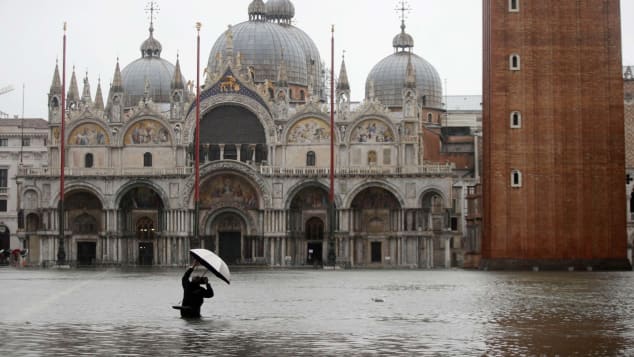
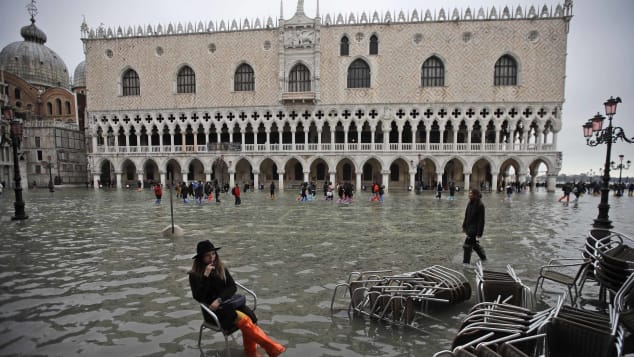
After the deluge: A tourist visits flood-hit Venice

Julia Buckley, CNN • Published 21st November 2019
As a tourist in Venice, you rarely get a glimpse of local life. Last week, though, tourists couldn't help but be co-opted into the five-day floods. Having a choice of a mere four pasta dishes doesn't equate to having €8,000 of damage caused to your business in a matter of minutes, of course; but for once, in a city where tourists seem to do as they please while locals pick up the pieces, tourists, too, were being inconvenienced.

Museums and churches closed
Churches were barred shut -- 50, or around half of them, have sustained serious damages, including the Byzantine Basilica di San Marco.
Museums and galleries, too -- Ca' Pesaro, the modern art gallery perched on the Grand Canal, is thought to have been so badly damaged that it'll be closed for three months, said a man eyeing up the damage at Palazzo Mocenigo, the (now reopened) museum of textiles and perfume.
On the Saturday, authorities were predicting tide levels of 115 centimeters (close to four feet) around midday. At 110 centimeters, almost 12% of the city is flooded; at 120 centimeters, over 35%. After 140 centimeters, over 90% of the city is swamped. Last week's flood peaked at 187 centimeters.


https://www.cnn.com/travel/article/visiting-venice-after-floods/index.html

Plan now: Three big storms could snarl Thanksgiving travel

Updated 12:10 PM ET, Fri November 22, 2019


According to AAA, 55 million people are expected to take to the roads, rails and skies during Thanksgiving week. But three big storms could slow your roll to grandma's house. Do keep in mind that Thanksgiving is a week away, and the forecast can change. But as of now, here's an early look at what you can expect.
Another storm will batter the Midwest Tuesday into Wednesday
Low pressure pushes east of the Rockies during the day on Tuesday, bringing a quick round of snow to the Plains before quickly strengthening and taking aim at the Midwest.

https://www.cnn.com/2019/11/22/weather/thanksgiving-week-weather-forecast/index.html

  • Chicago will start with rain Tuesday afternoon, then turn to snow late Tuesday. The snow should be out of Chicago by Wednesday morning.
  • Parts of Wisconsin and Michigan will get a round of heavy snow on Tuesday and early Wednesday before clearing out.
  • Behind the system, temperatures will drop 5 to 15 degrees. Much of the Midwest will have highs in the upper 30s to low 40s for Thanksgiving Day, with dry conditions. 

Australian koala population hit as wildfires rage

A historic droughts and brushfires sweep across Australia, koala populations have been decimated, according to some reports.

Deborah Tabart, the chairman of the Australian Koala Foundation, estimated that over 1,000 koalas have been killed from the fires, and as much as 80 percent of their habitat has been destroyed, Forbes reported.

The organization predicted that the Koala population was “functionally extinct” in May, when it estimated that there were fewer than 80,000 koalas left in the wild – prior to the recent casualties – the BBC reported. An animal is “functionally extinct” if it has so few pairs that it is unlikely to produce a new generation.


https://thehill.com/blogs/blog-briefing-room/news/471809-australian-koala-population-hit-as-wildfires-rage

They also play a shrinking role in their ecosystem, and their long-term viability as a species grows more unlikely, Forbes reported. 
Aside from the danger the koalas face directly from the fire, their main food supply, eucalyptus trees, are also unlikely to survive the flames. A fully-grown koala will eat up to two pounds of eucalyptus leaves per day. Although the trees are expected to grow back after the fire, it will leave the remaining koalas hungry for months.  
Some koala lovers are urging the Australian government to enact the Koala Protection Act, which was introduced in 2016 but never enacted. It would protect koala habitats and eucalyptus trees in addition to protecting koalas from hunting, according to Forbes.  
The Port Macquaria Koala Hospital set up a GoFundMe page for donations to help treat the injured koalas. They have already raised more than $1.3 million. The money will be used for the animals’ care and to build drinking stations in areas affected by the fire.

Wednesday, November 20, 2019

The Leonid meteor shower will be visible across the night sky

November 12, 2019
The peak of the Leonid meteor shower – an annual mid-November treat – will be visible across the night sky late Sunday night and especially early Monday morning.
The Leonids appear to be coming from the constellation Leo the Lion (hence their name) in the east, but they should be visible all the way across the sky.
One problem: A waning gibbous moon will light up the night sky this year, which could interfere with viewing the meteors. In a dark sky, absent of moonlight, you could see up to 10 to 15 meteors per hour at the typical peak of the shower, according to NASA.
This shower has been known to produce meteor storms, but no Leonid storm is expected this year, EarthSky said. A meteor storm is defined as having at least 1,000 meteors per hour, NASA said.
https://www.usatoday.com/story/news/nation/2019/11/12/meteor-shower-november-leonids-shooting-stars/2574968001/

Cows swept away by Hurricane Dorian found 3 months after swimming to safety

 / Source: TODAY
By Scott Stump

A trio of wild cows believed to have been swept away by the storm surge from Hurricane Dorian has been found on a nearby island in North Carolina.
It turns out the massive storm surge from Hurricane Dorian didn't entirely wipe out the wild horses and cows that lived on North Carolina's Cedar Island when it made landfall in September.
Three of the wild cows simply changed addresses.
Residents and national park officials were surprised to find three castaway cows living at Cape Lookout National Seashore Park on the Outer Banks, about 3 miles from where the animals had been living before Hurricane Dorian hit.
"The cows surviving has just been a blessing,'' local resident Rhonda Hunter told Kerry Sanders on TODAY Friday.

https://www.newsbreak.com/news/0NKuPzP0/cows-cast-away-by-hurricane-dorian-found-alive-on-nc-island

Australia drought: Thirsty cattle swarm New South Wales water truck

This is what happens when people read news only on Facebook. They get old news. But I will post it anyway because we were talking about drought last class. I cannot imagine how hard it has to be for the animals to be thirsty.

I did check and unfortunately, there is still drought in Australia.
08 August 2018
An Australian farmer has shared drone footage of cattle swarming around a water truck in the drought-hit state of New South Wales. 
The state, which produces about a quarter of Australia's agricultural output, is now entirely in drought, officials have confirmed.

https://www.bbc.com/news/av/world-australia-45112536/australia-drought-thirsty-cattle-swarm-new-south-wales-water-truck

Saturday, November 2, 2019

10 Extremely Rare Weather Events

For example:
Thundersnow - mimics the inner workings of a normal thunderstorm by forming through the upward movement of humid air. It’s the combination of lower humid air and higher cooler air that cause lightning and thunderstorms. This is exactly why thundersnow is so rare, seeing as how warm lower ground temperatures aren’t usually present while it’s snowing.

Multi-colored Snow - On a freezing cold morning in 2010, citizens of Stavropol, Russia woke up to multi-colored snow lining their streets. It wasn’t toxic, but the experts warned that it wouldn’t be wise to ingest any of the snow as it was most likely contaminated by dust all the way from Africa. The dust reached dizzying heights in the upper atmosphere where it mingled in with normal snow clouds. This interaction is what caused the beautifully colored snow to fall. That wasn’t the first time it happened — in 1912, black snow fell over Alaska and Canada. The black color was thanks to volcanic ash and rocks that also mingled with snow clouds.


Derecho - In 2012, a massive and violent storm system made up of several thunderstorms and strong windsleft a trail of destruction across the Midwest and mid-Atlantic. This terrifying type of storm is called a derecho, and in this case the storm was upgraded to a “super derecho” due to its severity. The main cause of the super-storm was the intense heat experienced over the area combined with a ripple in the jet stream. The state of Virginia experienced a massive power outage — cables snapped like twigs, trucks tumbled right over like they were made of cardboard and 13 people were killed.Derechos are very rare across the mid-Atlantic, only occurring every four years or so. Another extremely destructive derecho occurred in the United States in 2009. The storm system traveled 1000 miles in one day, leaving several dead and even more injured. A terrifying 45 tornadoes hit the ground during this storm.


Sunday, October 6, 2019

January 7, 2008 - Tornadoes in Far Southeast Wisconsin

I wanted to share with you the pictures from the devastation after the tornado from January 2008 in S Wisconsin that I took one day after. It happened by HWY 50; that was my route to work, but I did not go to work that day. When I saw the scattered houses everywhere, I felt the unstoppable power that went through the area. 


Experiencing a tornado in Wisconsin in January is extremely rare. In fact, it had only happened once between 1950 and 2007, when an F3 tornado affected parts of Green and Rock Counties on January 24, 1967. That tornado in South Central Wisconsin was part of a much larger outbreak of 30 tornadoes across mostly Iowa, Illinois and Missouri. Wisconsin ended up with 30 tornadoes in 1967. The 30-year average (1981-2010) annual number of tornadoes in Wisconsin is 23.
However, on the afternoon of January 7, 2008 a warm, moist, and unstable airmass, with temperatures rising into the lower 60s, moved into Southeast Wisconsin - setting the stage for a rare January severe weather event. Thunderstorms formed just ahead of a stationary front and produced hail, damaging winds, and a few tornadoes.
One of the thunderstorms tracked from just north of Rockford, Illinois into far Southeast Wisconsin. This supercell thunderstorm produced an EF-3 tornado in Northern Illinois. The same storm also produced two tornadoes in Wisconsin. The first tornado spun up in Southeast Walworth County and then tracked through the Wheatland and Brighton areas of Western Kenosha County. The second tornado occurred in the town of Somers and on the north side of the city of Kenosha.
In Walworth County, five structures sustained damage - three had minor damage and two had moderate damage. In Kenosha County, with both tornadoes combined, 105 homes sustained damage. 46 homes had minor damage, 32 had major damage and 27 were destroyed.
The tornado in the Wheatland area also marked the first confirmed tornado in Kenosha County since 2001 - a span of nearly 7 years! Also, Kenosha County had only seen 4 tornadoes between 1950 and 2007. The last tornado observed in Walworth County was in 2004.
The three tornadoes in Southeast Wisconsin and Northern Illinois were also part of a larger tornado outbreak on January 7th. The majority of the tornadoes occurred in Missouri, where 33 have been confirmed. In all, 48 tornadoes occurred spanning an area from Southeast Wisconsin through Eastern Oklahoma. A map depicting tornado tracks from the entire outbreak is depicted below.
https://www.weather.gov/mkx/010708-se-wi-tornadoes