Showing posts with label Stephanie Herron. Show all posts

Wednesday, December 11, 2013

While Most of U.S. Froze, Parts of Alaska Set Record Highs


While the continental U.S. has been shivering from coast-to-coast with temperatures dropping as low as minus-40°F amid one of the most severe early December cold snaps in several years, one state bucked the trend in an historic way.
The same contorted jet stream pattern that brought the brutal cold to the lower 48 states pushed a pulse of milder-than-average air into Alaska, where some spots recorded temperatures unheard of for December.
Along Alaska's northern coastline, which lies above the Arctic Circle, the warmest December temperatures on record in at least 70 years occurred this past week.
At the airport in Deadhorse, which serves the oil production hub of Prudhoe Bay, the temperature hit 39°F on December 7, the highest December temperature on record there since at least 1968, said Rick Thoman of the National Weather Service (NWS) in Fairbanks in an interview. Even more notable, perhaps, was the fact that it was raining, rather than snowing. Rain there is unusual so late in the year.
Previously, the highest December temperature recorded at any of the two climate observation sites that have served Prudhoe Bay over the years was 35°F, set on Dec. 31, 1973, according to Chris Burt, a blogger at Weather Underground.
Thoman said it’s possible, but not likely, that other climate stations in that area — such as data collected at now defunct Cold War-era early warning radar stations — recorded slightly milder December temperatures when they were operating in the 1950s and 1960s.
December high temperature records were also set or tied at Barter Island AFB, which is a tiny airport located on a sliver of land along Alaska’s wind-whipped North Slope region, and in the small village of Wainwright, another Arctic shore location. Barter Island reached 37°F, which tied its record last set in 1973, and Wainright hit 32°F, beating the old record of 30°F last set in 2006.
Some weather stations located along the Dalton Highway south of Prudhoe Bay saw temperatures climb into the 40s, Thoman said.
Other noteworthy Alaska records included a December record high of 54°F in King Salmon, which is situated along Bristol Bay in southwest Alaska. That broke the previous record of 51°F, and records there date back to World War II. Daily high temperature records were also set at Kotzebue, Bettles, and Cold Bay, Alaska, among other locations, Thoman said.
The first nine days of December ran 22.2°F above average in Barrow, and 18.5°F above average in Kotzebue, according to NWS data.
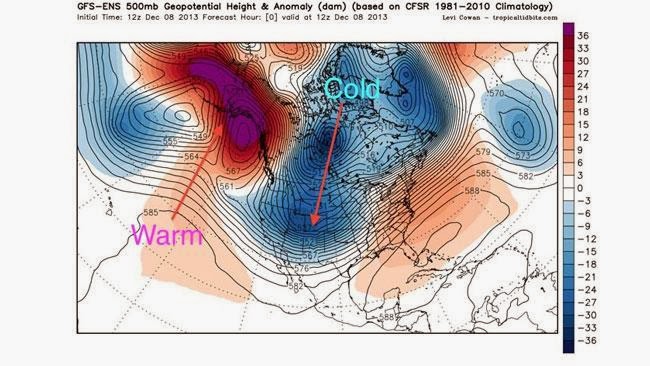
A strong ridge of high pressure was the main cause of the record warmth in Alaska. The high shunted the jet stream, which is a high speed current of winds in the upper atmosphere, to the north of the state, while simultaneously displacing cold, Arctic air southward into Canada and the continental U.S.
Thoman said such weather patterns are not uncommon during the winter months, although the extreme nature of this one was. “This kind of thing does happen with some frequency in the cold season,” Thoman said.
“You get these amplified patterns, and the cold air’s gotta go somewhere, so you build up the ridge somewhere over the Gulf of Alaska ... pump warm air into Alaska, and on the east side of that high, that cold air is going to come plunging south.”
In recent years, studies have shown an association between extremely wavy or “amplified” jet stream patterns, with large ridges and troughs, and Arctic sea ice melt and snow cover decline during the spring and summer months. It's an active area of research, but there’s no doubt that climate change has been having profound impacts in Alaska and other areas of the Arctic region.
The 2012 Arctic Report Card depicted a region undergoing rapid and pervasive changes related to manmade global warming, including the ramifications from plummeting spring and summer sea ice cover, melting permafrost, a rapid loss of spring snow cover, and various other climate change impacts.
The 2013 edition of the Report Card, published by the National Oceanic and Atmospheric Administration, will be released on Thursday.
Recent news reports from Alaska show that increasingly mild fall seasons and erratic weather patterns have had significant effects on local communities.
For example, In Wainwright, changes in weather patterns have diminished the opportunities for subsistence hunters to safely hunt whales and caribou during the fall harvest season, according to a new study published in the journal Arctic.
Alaskans have also seen a precipitous decline in the Western Arctic Caribou Herd, which is thought to be a result, at least in part, of an increase in fall freezing rain events. A colder atmosphere used to produce more snow events, but ice storms have become more common along the caribou’s migration routes, which is helping to thin the herd, according to reporting by the Alaska Dispatch.
Although the long-term forecast calls for continued warming during the next several decades, in the near term, the high pressure area over Alaska is weakening, allowing colder air and snowier weather to return to the Frontier State, Thoman said.
The upcoming weather pattern will be “A big change from what we’ve had, that’s for sure,” Thoman said

While Most of U.S. Froze, Parts of Alaska Set Record Highs


While the continental U.S. has been shivering from coast-to-coast with temperatures dropping as low as minus-40°F amid one of the most severe early December cold snaps in several years, one state bucked the trend in an historic way.
The same contorted jet stream pattern that brought the brutal cold to the lower 48 states pushed a pulse of milder-than-average air into Alaska, where some spots recorded temperatures unheard of for December.
Along Alaska's northern coastline, which lies above the Arctic Circle, the warmest December temperatures on record in at least 70 years occurred this past week.
At the airport in Deadhorse, which serves the oil production hub of Prudhoe Bay, the temperature hit 39°F on December 7, the highest December temperature on record there since at least 1968, said Rick Thoman of the National Weather Service (NWS) in Fairbanks in an interview. Even more notable, perhaps, was the fact that it was raining, rather than snowing. Rain there is unusual so late in the year.
Previously, the highest December temperature recorded at any of the two climate observation sites that have served Prudhoe Bay over the years was 35°F, set on Dec. 31, 1973, according to Chris Burt, a blogger at Weather Underground.
Thoman said it’s possible, but not likely, that other climate stations in that area — such as data collected at now defunct Cold War-era early warning radar stations — recorded slightly milder December temperatures when they were operating in the 1950s and 1960s.
December high temperature records were also set or tied at Barter Island AFB, which is a tiny airport located on a sliver of land along Alaska’s wind-whipped North Slope region, and in the small village of Wainwright, another Arctic shore location. Barter Island reached 37°F, which tied its record last set in 1973, and Wainright hit 32°F, beating the old record of 30°F last set in 2006.
Some weather stations located along the Dalton Highway south of Prudhoe Bay saw temperatures climb into the 40s, Thoman said.
Other noteworthy Alaska records included a December record high of 54°F in King Salmon, which is situated along Bristol Bay in southwest Alaska. That broke the previous record of 51°F, and records there date back to World War II. Daily high temperature records were also set at Kotzebue, Bettles, and Cold Bay, Alaska, among other locations, Thoman said.
The first nine days of December ran 22.2°F above average in Barrow, and 18.5°F above average in Kotzebue, according to NWS data.
A strong ridge of high pressure was the main cause of the record warmth in Alaska. The high shunted the jet stream, which is a high speed current of winds in the upper atmosphere, to the north of the state, while simultaneously displacing cold, Arctic air southward into Canada and the continental U.S.
Thoman said such weather patterns are not uncommon during the winter months, although the extreme nature of this one was. “This kind of thing does happen with some frequency in the cold season,” Thoman said.
“You get these amplified patterns, and the cold air’s gotta go somewhere, so you build up the ridge somewhere over the Gulf of Alaska ... pump warm air into Alaska, and on the east side of that high, that cold air is going to come plunging south.”
In recent years, studies have shown an association between extremely wavy or “amplified” jet stream patterns, with large ridges and troughs, and Arctic sea ice melt and snow cover decline during the spring and summer months. It's an active area of research, but there’s no doubt that climate change has been having profound impacts in Alaska and other areas of the Arctic region.
The 2012 Arctic Report Card depicted a region undergoing rapid and pervasive changes related to manmade global warming, including the ramifications from plummeting spring and summer sea ice cover, melting permafrost, a rapid loss of spring snow cover, and various other climate change impacts.
The 2013 edition of the Report Card, published by the National Oceanic and Atmospheric Administration, will be released on Thursday.
Recent news reports from Alaska show that increasingly mild fall seasons and erratic weather patterns have had significant effects on local communities.
For example, In Wainwright, changes in weather patterns have diminished the opportunities for subsistence hunters to safely hunt whales and caribou during the fall harvest season, according to a new study published in the journal Arctic.
Alaskans have also seen a precipitous decline in the Western Arctic Caribou Herd, which is thought to be a result, at least in part, of an increase in fall freezing rain events. A colder atmosphere used to produce more snow events, but ice storms have become more common along the caribou’s migration routes, which is helping to thin the herd, according to reporting by the Alaska Dispatch.
Although the long-term forecast calls for continued warming during the next several decades, in the near term, the high pressure area over Alaska is weakening, allowing colder air and snowier weather to return to the Frontier State, Thoman said.
The upcoming weather pattern will be “A big change from what we’ve had, that’s for sure,” Thoman said

Thursday, October 31, 2013

Dust Storm Between Phoenix and Tucson: At Least 3 People Killed

CASA GRANDE, Ariz. -- A stream of thick, blowing dust crossing an Arizona highway led to a chain-reaction crash that killed three people in an area where gusting winds often stir up towering clouds of dirt that can reduce visibility to zero.
At least 12 other people were injured Tuesday in the 19-vehicle pileup on Interstate 10 between Phoenix and Tucson.
Crews brought in portable lights as they worked past sunset to pry apart the 10 commercial vehicles, seven passenger cars, one tanker and one recreational vehicle that were involved, Arizona Department of Public Safety officials said.


Arizona DOT
A look at one of the crashes along westbound I-10 in Phoenix Tuesday afternoon.
Television footage showed at least one car pinned between two 18-wheelers and others wedged under big rigs near Picacho Peak in south-central Arizona.
Henry Wallace told KPHO-TV he got out of his car just in time before the chain-reaction crashes began.
"One truck hit another truck. Cars start piling into each other, and they pushed that one truck right into me and off to the side of the road," Wallace said. "I couldn't see anything because the (dust) was so thick, but I could just hear it, `Boom, boom, boom, boom, boom.'"
Medical helicopters airlifted several of the injured to hospitals in Tucson and Phoenix, and DPS officials said at least one person was in critical condition.
Gordon Lee Smith, 76, of Mead, Wash., was identified as one of the people who died. Smith's wife was injured, DPS officials said, but her condition wasn't disclosed.
The names and hometowns of the other two killed weren't immediately available.
DPS investigators were interviewing survivors to determine the chain of events.
(ALERTS: Arizona Weather Alerts)
"This could be three, four or even five crashes. That's where the interview comes in with the drivers and witnesses," DPS Officer Carrick Cook said.
"That area of I-10 is historically known for these blowing dust storms that come through," Cook added. "At the time of this crash, there were reports that there was zero visibility in the road, and with these dynamic systems that come through so quickly, people are often surprised by it."
The National Weather Service had issued a blowing dust advisory shortly before the crashes, with wind gusts of up to 30 mph reported in the area.
"A steady southwest wind created channels of dense, blowing dust," weather service meteorologist Chris Dunn told KPHO. "Unfortunately, one of those localized channels of dust ended up over a busy Arizona interstate."
DPS spokesman Bart Graves said Tuesday's crash was one of the worst chain-reaction accidents in that area in the past seven years.
Parts of westbound I-10 were closed for more than five hours.
The Arizona Department of Transportation recommends that motorists who find themselves in a dust storm pull completely off the paved portion of the road, turn off all lights including emergency flashers, set the emergency brake, keep feet off the brakes so others don't try to follow the tail lights, and stay in the vehicle with seat belts fastened.
 

Strong Earthquake Hits Eastern Taiwan

TAIPEI, Taiwan – A strong earthquake hit eastern Taiwan on Thursday, shaking buildings over a wide area including the capital. There were no immediate reports of serious damage or casualties.

The U.S. Geological Survey said the earthquake struck at 8:02 p.m. and measured magnitude 6.3. It was centered in a remote mountainous area 45 kilometers (28 miles) south-southwest of the coastal city of Hualian at a depth of just 12 kilometers (7.5 miles), it said.

In the capital, Taipei, about 150 kilometers (95 miles) from the epicenter, buildings swayed for more than 10 seconds and startled residents ducked for cover.

Taiwan's railway administration immediately suspended train service while it checked for any possible damage to tracks.
(VIDEO: How Earthquakes Happen)

Authorities reported scattered power outages in northern Taiwan. In at least two locations in the Taipei suburbs crews were working to extricate people trapped in stalled elevators.

Local TV channels reported that there appeared to be almost no damage in Hualian. However, it could take some time for the full impact of the quake to be evaluated because of the remoteness of the epicenter.

Newer buildings in Taiwan are built to withstand strong earthquakes, so damage in major cities tends to be limited. This is not the case for buildings constructed before the 1980s, when construction standards were less rigorous.

Earthquakes frequently rattle Taiwan, but most are minor and cause little or no damage.

However, a magnitude-7.6 earthquake in central Taiwan in 1999 killed more than 2,300 people.

India: Sept. 29, 1993
The first of two of the top-10 deadliest earthquakes of the last 25 years that occurred in India was a 6.2 temblor that killed 9,748, according to the USGS. (DOUGLAS E. CURRAN/AFP/Getty Images)

Thursday, October 24, 2013

Volcano at Indonesia's Mount Sinabung Spits Powerful Burst of Ash

MEDAN, Indonesia -- A volcano in western Indonesia erupted on Thursday, unleashing a column of dark volcanic material high into the air weeks after villagers were returning home from an earlier eruption, officials said.
The explosion at Mount Sinabung, located in North Sumatra province, shot black ash nearly 2 miles into the air, but there were no reports of injuries or damage, said National Mitigation Agency spokesman Sutopo Purwo Nugroho.


In this time exposure taken from Karo district late September 18, 2013, lightning strikes next to Mount Sinabung volcano as it spews steam and ash.
He said villages, farms and trees around the 8,530-foot-high rumbling volcano were covered in thick gray ash, prompting authorities to evacuate more than 3,300 people. Most were from two villages within 2 miles of the mountain in Karo district.
No lava or debris spewed from the volcano, and nearby towns and villages were not in danger, but authorities warned tourists to stay away from the danger zone located 1 mile from the crater, Nugroho said.
Last month, more than 15,000 people were forced to flee when the volcano rumbled to life after being dormant for three years, belching ash and smoke and igniting fires on its slopes.
The volcano's last major eruption in August 2010 killed two people and forced 30,000 others to flee. It caught many scientists off guard because it had been quiet for four centuries.
Mount Sinabung is among more than 120 active volcanoes in Indonesia, which is prone to seismic upheaval due to its location on the Pacific "Ring of Fire," an arc of volcanos and fault lines encircling the Pacific Basin.


Heavy Fog Covers Seattle, Vancouver and Other Pacific Northwest Cities


Coastal cities in the Pacific Northwest have been dealing with rounds of heavy fog all week long. The fog has been so relentless, locals are calling it 'Fogmaggedon' and 'Fogtober.'
According to The Weather Channel meteorologist Tom Moore, Thursday marked six straight days of persistent, heavy fog for Seattle. Moore says the fog could hang around through the weekend.
(MORE: Fog from Space)
The weather has caused delays throughout the week at Seattle-Tacoma International Airport. The heavy fog has also been tough on marine traffic. King5.com reports the Washington state ferry MV Cahtlamet came close to colliding with a 63-foot fishing boat Thursday morning.
The Storify below captures some of the best photos we could find that show the fog in Seattle as well as just north of the border in Vancouver, Canada.


Arctic Temperatures Warmest In More Than 40,000 Years


Arnaq Egede works among the plants in her family's potato farm in July in Qaqortoq, Greenland. The farm, the largest in Greenland, has seen an extended crop growing season due to climate change.

Plenty of studies have shown that the Arctic is warming and that the ice caps are melting, but how does it compare to the past, and how serious is it?
New research shows that average summer temperatures in the Canadian Arctic over the last century are the highest in the last 44,000 years, and perhaps the highest in 120,000 years.
"The key piece here is just how unprecedented the warming of Arctic Canada is," Gifford Miller, a researcher at the University of Colorado, Boulder, said in a joint statement from the school and the publisher of the journal Geophysical Researcher Letters, in which the study by Miller and his colleagues was published online this week.

"This study really says the warming we are seeing is outside any kind of known natural variability, and it has to be due to increased greenhouse gases in the atmosphere."
The study is the first to show that current Arctic warmth exceeds peak heat there in the early Holocene, the name for the current geological period, which began about 11,700 years ago. During this "peak" Arctic warmth, solar radiation was about 9 percent greater than today, according to the study.
Miller and his colleagues gauged Arctic temperatures by looking at gas bubbles trapped in ice cores (cylinders drilled from the ice that show layers of snow laid down over time) taken from the region, which allows scientists to reconstruct past temperature and levels of precipitation.
They paired this with radiocarbon dating of clumps of moss taken from a melting ice cap on Canada's Baffin Island. Their analysis shows that these plants have been trapped in the ice for at least 44,000 years, and perhaps as long as 120,000 years. Taken together, that data suggest temperatures in the region haven't been this high since perhaps as long as 120,000 years ago, according to the study.
The Arctic has been heating up for about a century, but the most significant warming didn't start until the 1970s, Miller said in the statement. "And it is really in the past 20 years that the warming signal from that region has been just stunning," he added. "All of Baffin Island is melting, and we expect all of the ice caps to eventually disappear, even if there is no additional warming."

Ecosystem could take 'decades' to recover from BP oil spill

Oil floating in the Gulf of Mexico following the BP oil spill (creative commons photo courtesy


 Deep sea soft-sediment is home to countless organisms that represent the bottom of the food chain -- but in the Gulf of Mexico, the sea floor was damaged from the BP oil spill, and it could take "decades" to recover, a recent paper published in the scientific journal PLoS One has found.
The BP oil spill - also referred to as the Deepwater Horizon oil spill - erupted on April 20, 2010. The 87-day disaster is considered to be one of the largest oil spills in U.S. history. Eleven people died and more than 4 million barrels of oil were spilled into the Gulf of Mexico between April 20 and July 15, 2010, causing extensive damage to bird sanctuaries, marine and wildlife habitats.
Massive losses were reported in the fishing and tourism industries as well.
Numerous studies have been conducted in the aftermath of the spill, but this is the first paper to provide insight into the effect the disaster has had on the Gulf's base food chain.
"As the principal investigators, we were tasked with determining what impacts might have occurred to the sea floor from the Deepwater Horizon oil spill," said Paul Montagna, Ph.D., Endowed Chair for Ecosystems and Modeling at the Harte Research Institute, in a statement.
"We developed an innovative approach to combine tried and true classical statistical techniques with state of the art mapping technologies to create a map of the footprint of the oil spill."
According to Montagna, a typical drilling site creates pollution 300-600 metres away.
But with the BP spill, pollution was found 3,200 metres -- or about 3 km -- from the site, with "identifiable impacts" more than 16 km away.
"The tremendous biodiversity of meiofauna in the deep­sea area of the Gulf of Mexico we studied has been reduced dramatically,” said Jeff Baguley, Ph.D., University of Nevada in a statement.
"Nematode worms have become the dominant group at sites we sampled that were impacted by the oil. So though the overall number of meiofauna may not have changed much, it’s that we've lost the incredible biodiversity."
The complete study can be found online at PLoS One.

Australia fire crews face extreme weather in NSW


The BBC's Emily Thomas: "The worst could be yet to come"

More than 3,000 firefighters in Australia are battling devastating bushfires raging across New South Wales as weather conditions worsen.

"This will be as bad as it gets," Rural Fire Service chief Shane Fitzsimmons said, adding there was "real potential for more loss of homes and life".

High temperatures, low humidity and strong winds of up to 100km/h (60mph) were forecast for Wednesday.

In total, 71 fires are burning across the state, 29 of which are uncontained.

Hundreds more firefighters have been deployed to the Blue Mountains, to the west of Sydney, to work alongside the 1,000 already there, making it one of the largest firefighting contingents ever assembled in the state's history.

Residents have been urged to leave affected areas. Hundreds of nursing home residents were evacuated late on Tuesday and all schools in the area are closed.


"We are all in this together and we are going to get through this day. If you haven't prepared yourself, for those in the Blue Mountains, now is the time to leave," NSW Premier Barry O'Farrell said at a news conference on Wednesday morning.

"We hope, of course, today's conditions and potential events do not occur. We've planned for the worst but we continue to hope for the best."

Up to 5mm (0.2in) of rain fell across fire grounds on Tuesday night and into Wednesday morning.

"Whilst that is some welcome relief in terms of moderating the current fire behaviour, it has compromised considerably the ability to continue with the back-burning operations that were planned throughout the evening," Mr Fitzsimmons said.

Back-burning is controlled burning of key areas aimed at depriving a fire of fuel and prevent it travelling in a certain direction.

Burnt houses seen from inside a burnt-out car in the Blue Mountains suburb of Winmalee, 21 October 2013 The fires have gutted cars and destroyed more than 200 properties

A fire fighter works to control flames near houses in Bilpin, Australia, 22 October 2013 Hundreds of extra firefighters are being deployed in NSW

In the Blue Mountains, there are three "watch-and-act" alerts in place for the State Mine fire near Lithgow, the Mount Victoria fire and the Hall Road fire near Wollondilly. There is an "emergency" alert in place for the Linksview Road fire near Springwood, according to the NSW Rural Fire Service.

On Tuesday fire crews deliberately joined two large fires - State Mine and Mount Victoria - in order to prevent them linking up with a third to create a massive blaze.

The fires have been burning in the Blue Mountains since Thursday, with a state of emergency declared at the weekend.

"There's not been fires quite like this before - so big, so intense and so fast. We're talking about a fire that at some points is five storeys high," Mayor of the Blue Mountains Mark Greenhill told the BBC on Tuesday.

"[Wednesday] is going to be a horror day in terms of the weather and could be a horror day in terms of the fire," he said.

Bushfires in Australia

Australia is often hit by bushfires during summer months from December to February. Causes can be lightning, arson, power-line arcing, dropped cigarettes or controlled burns that go wrong.
On 7 February 2009 a prolonged heat-wave and dry spell led to the Black Saturday bushfires in Victoria. The fires became Australia's worst natural disaster, killing 173 people and burning thousands of houses.
On 16 February 1983 almost 200 fires caused devastation across parts of Victoria and South Australia. Seventy-five people died in what became known as the Ash Wednesday fires.
In January 2013, parts of NSW and Tasmania were hit by fires as temperatures soared to record levels, with average national temperatures topping 40 degrees Celsius. One person died in Tasmania and several hundred buildings were destroyed.

Police and Emergency Services Minister Michael Gallacher said residents in the Blue Mountains needed to have a plan.

"Pack the car now, head down the mountain, come down and enjoy time in the metropolitan area and allow the firefighters the freedom to move through the community to protect your homes," he said.

Sam Buckingham-Jones, who is from Springwood, said he was ready to evacuate if necessary.

"There has been a very strong wind today, about 100km/hr," he told the BBC.

"There is a bushfire only 5km (three miles) away from where we live. Everyone here is talking about what would they take with them if they have to evacuate - we packed a lot of stuff in the cars and we are ready to leave if we have to."

Further north, two "emergency" alerts has been issued for fires on the outskirts of Newcastle, with residents in Minmi told to leave and a major highway closed.

So far the fires in New South Wales have destroyed more than 200 homes. One man has died, possibly of a heart attack while defending his home.

Minister Michael Gallacher: "Things are heating up"

New Prime Minister Tony Abbott, meanwhile, has hit back at comments by UN climate chief Christiana Figueres linking bushfires to global warming and criticising his decision to repeal a tax on carbon emissions introduced by the previous government.

"The official in question is talking through her hat," Mr Abbott told local media.

"Climate change is real, as I've often said, and we should take strong action against it. But these fires are certainly not a function of climate change - they're just a function of life in Australia."

Mr Abbott, who took office in September, has drafted legislation to repeal the carbon tax, which imposed a levy on the country's 300 biggest polluters.

The new prime minister, who says the tax cost jobs and forced energy prices up, wants to introduce a Direct Action plan under which farmers and industry will be paid to act to reduce emissions.

Satellite image showing the location of the fires near Sydney, Australia

Landslide Sensors May Save Lives Worldwide


Using technology found in cell phones, inexpensive sensors being tested at Monte Sano State Park might one day soon save lives by giving advance warning of deadly landslides in at-risk areas around the world.

 
The wireless test sensors are installed around an active landslide zone in the park. A team from the Atmospheric Science Department at The University of Alabama in Huntsville is studying the sensors ­to see whether they can provide useful information about soil stability and the likelihood of an impending landslide.
Recent research estimated that more than 4,500 people are killed and thousands of others are injured in landslides around the world every year.
What makes UAH's low cost sensors unique is, first, that they are low cost. In addition to weather instruments, they also use off-the-shelf technology that was developed for other uses, such as motion detectors that also are used in cell phones (for game controllers or to tell the phone how it is oriented) and in robotics. The sensor that tells when the soil is so saturated by rain that it might become unstable was developed for irrigation systems, to tell when a field has received enough water.
The bigger savings, however, are in the cell phone technology itself. Previous sensor packages that provided real-time environmental data generally required either a hard wire connection or expensive uplink hardware. Research instruments that weren't connected by wire had to be routinely serviced, both to collect the data and to change batteries.
The UAH sensors connect to the Internet using inexpensive cell phone connections, so scientists at the university can monitor their instruments without needing to either run wires into remote areas or have someone visit the sensor boxes on a regular basis.
Eric Anderson, a research associate in UAH's Earth System Science Center, learned about the wireless sensors -- which were conceived developed by a University Space Research Association (USRA) scientist in Huntsville's National Space Science and Technology Center -- while he was a research scientist in Panama.
During the three years he was there, Anderson saw the destruction caused by landslides throughout Central America.
"It is a problem almost every year in areas with steep slopes and heavy rainfall," he said. "El Salvador, Honduras, Nicaragua and throughout the region, in many places it is a disaster waiting to happen. The soil types found in that region also are more prone to landslides, especially the volcanic and clay soils.
"Unfortunately, the volcanic soils also are some of the richer soils, better for farming, so landslide-prone areas with volcanic soils tend to be more densely populated."
After enrolling in the Earth system science program at UAH, Anderson also went to work with NASA, giving him access to Karthik Srinivasan, the USRA scientist who invented developed the wireless sensors for NASA's SERVIR program. The sensors were created as a low-cost tool for calibrating an airborne instrument that measures soil moisture. Because they were self-contained, those first sensors could be moved from spot to spot as needed to gather data on the ground at the same time the airborne instrument was overhead.
After seeing the sensors in action, Anderson recognized the potential value something similar might have in studying and monitoring landslides. He took his idea to Dr. Udaysankar Nair, an associate professor of atmospheric science.
"That's one of the things that makes this project so unique, is that it was initiated by a graduate student," said Nair, who with two graduate students is Anderson's collaborator in the sensor project. Nair and Anderson wrote a proposal that led to a $56,000 grant from UAH's University Research Infrastructure Initiative. UAH graduate students Aaron Kaulfus and Brian Freitag field tested the sensor network and are testing computer models that could be linked to the network to provide the capability to predict landslides.
While that might have been enough money to buy one or two traditional sensor kits, they bought enough parts to build about a dozen of the cell phone-based instrument packages. The power supply is camping lantern batteries recharged by solar cells. Because the instruments are small and energy efficient, the solar arrays needed to keep the batteries charged are small.
Because cell phone service is now available in many undeveloped areas where regular hard-wire telephone lines were too expensive to install (and satellite phone service is available almost everywhere), these sensors could have use far beyond monitoring landslides. The NASA/USRA team has installed a set of similar sensors in Bangladesh to provide flood monitoring and warnings.
Nair is interested in the potential value these sensors might have in two of his ongoing research programs: forecasting the spread of smoke from planned forest fires and studying weather patterns around Mount Kilimanjaro in Africa. In both cases, being able to set out a network of low-cost sensors without hard wire connections could be useful.
"You can create a network and monitor the whole thing," he said. "You can also have a small microprocessor on site to run models and analyze the data as it's coming in. That gives you the ability to do things like provide real-time warnings without needing a person in the loop 24-7. If you have the network there, it can collect the information and do all the processing. It does all it needs to do right there."

Hurricane Raymond weakens off Mexico coast, still rain threat

Ricardo Mesino Flores walks through what is left of his home, which was destroyed previously by Tropical Storm Manuel, as it is again flooded by Hurricane Raymond in the community Papa Gallo de Tierra Colorada near Acapulco, Mexico, Tuesday, Oct. 22, 2013.
Ricardo Mesino Flores walks through what is left of his home, which was destroyed previously by Tropical Storm Manuel, as it is again flooded by Hurricane Raymond in the community Papa Gallo de Tierra Colorada near Acapulco, Mexico, Tuesday, Oct. 22, 2013. / AP Photo/Marco Ugarte
ACAPULCO, Mexico Hurricane Raymond weakened to barely a Category 1 storm Tuesday while still stalled off Mexico's Pacific coast, pumping rain onto an already sodden region recovering from a battering by a tropical storm last month.

Raymond was centered 100 miles (160 kilometers) from the beach resort of Zihuatanejo Tuesday evening, and its winds had dropped to 75 mph (150 kph), down from Category 3 on Monday, the U.S. National Hurricane Center said. It was expected to weaken to a tropical storm by Wednesday and head out to sea.

But stung by the tardy reaction to the damage and deaths from Tropical Storm Manuel in September, authorities in Guerrero state took no chances, moving hundreds of people from isolated mountain communities and low-lying shore areas. More than 1,500 soldiers were sent into the area.

Even if Raymond didn't move inland, it could still cause floods and mudslides to an area reeling from more than $1.7 billion in damage and about 120 deaths from Manuel.

"Slow and erratic motion is expected during the next 12 hours and Raymond could still move closer to the coast of Mexico," the hurricane center said.

Guerrero Gov. Angel Aguirre urged people to stay off roads because of potentially dangerous rains.

"The phenomenon's behavior is completely erratic, completely unpredictable," Aguirre said Monday night.

There were no reports of torrential downpours, but rain fell and some streets flooded in soaked Acapulco, where city workers reinforced roads with sand bags. About 400 people were evacuated from hamlets around nearby Coyuca.

In the mountain town of El Paraiso, authorities evacuated about 500 residents by Tuesday evening and planned to completely empty the village of 7,000 people because of possible landslides, said Guerrero state's deputy secretary of civil protection, Constantino Gonzalez.

Schools in most coastal communities west of Acapulco, including Zihuatanejo, were kept closed.

Forecasters said Raymond was expected to follow an erratic path through the night and could bring as much as 12 inches (30 centimeters) of rain to some parts of the coast.

About 10,000 people in Guerrero already were living away from their homes a month after Manuel inundated whole neighborhoods and caused landslides that buried much of one village. It left behind drenched hillsides that pose serious landslide risks.

A hurricane warning was in effect from Tecpan de Galeana, up the coast from Acapulco, north to the port of Lazaro Cardenas. A tropical storm warning was posted from Acapulco to Tecpan.

Meanwhile in the Atlantic, Tropical Storm Lorenzo strengthened far out to sea. Lorenzo's maximum sustained winds were over 50 mph (80 kph) with little change in strength forecast. The storm was centered about 830 miles (1,335 kilometers) east of Bermuda and was moving east near 8 mph (13 kph).

What's the weather like on Titan? 'Salt flats' provide new clues

Image: Titan lakes
NASA / JPL-Caltech / SSI
This false-color mosaic, made from infrared data collected by NASA's Cassini spacecraft during a Sept. 12 flyby, reveals the differences in the composition of surface materials around hydrocarbon lakes at Titan, Saturn's largest moon.

Fresh images of the hydrocarbon lakes on Titan reveal what appears to be the extraterrestrial equivalent of salt flats — a discovery that adds yet another layer of mystery to Saturn's largest moon.
Titan is permanently shrouded in a methane-rich haze, making it the only moon in the solar system to have a dense atmosphere. Instruments on NASA's Cassini orbiter, however, can cut through the haze and see what lies beneath.
During previous flybys, Cassini's cameras have mapped chilly lakes of methane and ethane in Titan's northern hemisphere. The readings have led scientists to believe that there's a "hydrologic cycle" at work, with hydrocarbons raining down onto the surface, collecting in the lakes, and evaporating back into the atmosphere.
In the past, the spacecraft's visual and infrared mapping spectrometer has been able to capture only distant or oblique views of the lakes and surrounding terrain. But during flybys in July and September, the VIMS instrument got a much better view — thanks to seasonal changes on Titan, rain-free weather and an improved viewing geometry.
The new images appear to shed light on a key stage of Titan's weather cycle — the stage that puts the liquid hydrocarbons back into the atmosphere.
"Many of these northern liquid bodies are surrounded by a bright material not seen elsewhere on Titan," Carolyn Porco, head of the Cassini imaging team, wrote in an email introducing the new pictures on Wednesday. "Is this an indication that with increased warmth, the seas and lakes are starting to evaporate, leaving behind a deposit of organic material ... or, in other words, the Titan equivalent of a salt flat?"
Image: Titan lake region
NASA / JPL-Caltech / SSI
An annotated infrared image shows the region around some of Titan's northern lakes, and highlights what appear to be evaporite deposits on the surface surrounding the lakes. The evaporites are indicated as false-color orange spots.

In the color-coded imagery, the bright material shows up as orange against the greenish backdrop of Titan's "bedrock" of water ice. Scientists suspect that the material consists of organic chemicals that were once suspended in Titan's haze. Those chemicals could have dissolved into pools of methane — and when the liquid evaporated, the organics were left behind.
Scientists don't yet know exactly what the material is made of. "They are the equivalent of salt flats on Earth, but the compounds on Titan aren't actually salts since they are probably nonpolar, like methane and ethane themselves," Jason Barnes, a participating scientist for the VIMS instrument at the University of Idaho, told NBC News in an email.
Referring to the material as "organic" simply means it contains carbon atoms. In this context, the term doesn't imply that the stuff was created as a result of life's processes. However, Titan's environment is thought to allow for the kind of prebiotic chemistry that preceded life's rise on Earth.
Titan's obscuring haze makes it tricky to trace that chemistry in detail, but Cassini is helping researchers get to the bottom of the mystery.
"The view from Cassini's visual and infrared mapping spectrometer gives us a holistic view of an area that we'd only seen in bits and pieces before and at a lower resolution," Barnes said in a NASA news release. "It turns out that Titan's north pole is even more interesting than we thought, with a complex interplay of liquids in lakes and seas and deposits left from the evaporation of past lakes and seas."

UK weather: Worst storms for 26 YEARS forecast with 90mph winds set to batter Britain


Britain is set to be battered by 90mph winds as forecasters warn of the worst weather since the Great Storm of 1987.
As thousands of families prepare for the beginning of half term, huge areas could be besieged with the worst conditions in more than two decades.
Experts predict a significant storm could develop close to the UK starting on Sunday night.
By Monday morning the exceptionally strong winds are predicted to ravage the southern half of the UK, before powerful tornado type storms, capable of bringing down trees or causing structural damage, spread further towards the midlands and north.
Energy companies have issued warnings of potential major disruption to transport and power cuts.
Met Office senior forecaster Helen Chivers said: ‘There is potential for a big storm to hit at the end of the weekend.
“But even before this storm there will be heavy rain and strong wind moving across the UK with very unsettled conditions.
“The storm could move to the south of us, but at the moment it looks as though it will be moving across the central parts of the UK , with the risk of strongest wind in Humber to mid wales south, with speeds of 70 - 80mph.
“There is potential across the extreme south coast of up speeds of up to 90mph.
“This is not a storm you see every winter. The storm of 1987 is one, and the Burns day storm in January 1990 is another.
“It is important to realise the track of this low is at the moment not certain. In this type of situation it is really, really important that people keep up to date with the most up to date warnings.”
 

The Environment Agency has issued more than 20 flood alerts for north England, the Midlands, the South East and Wales, and motoring organisations are urging drivers take extra care in wet weather.
The Met Office has also issued a number of severe weather warnings, for the Central, Tayside and Fife, London and the South East, south-west Scotland, Lothian Borders, the South West, Strathclyde and Wales.
Experts say the storm has shown particularly unusual signs, developing much closer to the UK and potentially tracking across the country while still in its most powerful phase.
A strong jet stream and warm air close to the UK are both contributing to the development and strength of the storm.
Despite predicted above-average temperatures The Met Office last night said gale force winds and heavy rain are triggering severe weather warnings into next week.
Matt Dallaway from motoring group RAC, said: “While cars have improved significantly in technical terms in recent years they are still not waterproof and will break down if they are driven through deep water.”


Wednesday, October 23, 2013

Landslide Danger Looms in Next Seattle Earthquake


A home on Seattle's steep and scenic slopes comes with a hidden risk. The next earthquake on the Seattle Fault, which cuts under the heart of the city, could trigger many more deadly landslides than previously predicted, a new study finds.
The risk of landslides in Seattle comes as no surprise to its residents. Every winter, heavy rains soak the ground atop a clay layer buried in some spots, until the layers grow so wet they slip and slide away. Most sediments in Seattle are "unconsolidated," jumbled piles left behind by glaciers that plowed through the Northwest during the last global cooling.
These loose soils can also collapse from earthquake shaking. To estimate the future risk of earthquake-triggered landslides, researchers at the University of Washington created a computer model of a magnitude-7.0 Seattle Fault earthquake and tested the shaking effects on Seattle slopes and soils. The findings were published today (Oct. 21) in the journal the Bulletin of the Seismological Society of America.

The landslides were concentrated on coastal bluffs and in southern parts of Seattle's metropolis, near the fault. And the risk of slumps and slips was worse in the winter, when the ground was wet. But some of the landslides set off by the earthquake were outside of the city's known risk zones.
"We found that one-third of the landslides triggered in the simulation were not already in areas defined as prone to landslides," said study author Kate Allstadt, a graduate student in seismology at the University of Washington. "A lot of times people say that they already know where the slopes are unstable, but this illustrates that we need to do dedicated studies on seismically induced landsliding."
During wet, winter conditions, the earthquake simulation found 8,000 buildings were in landslide hazard zones. The slides were also likely to cut off highways and railroad lines. During dry conditions, 1,000 buildings were in hazard zones.
The last big earthquake on the Seattle Fault was around A.D. 900, according to geologic studies and Native American oral history. The 30-mile-long (48 kilometers) fault strikes east-west across Puget Sound, near downtown Seattle and Bainbridge Island.
On the bottom of Lake Washington stand trees, still upright, that slid into the lake atop a huge landslide triggered by the last Seattle Fault temblor.
"That is the most haunting thing to me," Allstadt told LiveScience. "Today, there are all these mansions on those hills. Everybody wants a view of Puget Sound or Mount Rainer. What if that happened today?"
The chance of another shaker hitting in the next 50 years is about 5 percent, scientists forecast. On average, the Seattle Fault rips loose with an earthquake every 750 years