Wednesday, December 11, 2013

Snowflakes Like You've Never Seen (PHOTOS)

By Camille Mann Published: Dec 9, 2013, 4:35 PM EST weather.com

Macro Snowflakes

Snowflake macro shot taken in January 2009 shot on green plastic carpet. (Alexey Kljatov)
Each snowflake that falls has an intricate design that is all its own. Russian photographer Alexey Kljatov decided to take a close-up look at the ice crystals for his stunning photo series.
“When I bought my first digital camera, I was impressed by it’s ability to capture the tiny world, almost unseen by the naked eye,” explained Kljatov to weather.com.
After seeing shots of snowflakes on the internet Kljatov was “amazed by their cold crystal beauty” and was inspired to take some shots of his own.
When Kljatov was taking his first macro snowflake shots, he says he made a lot of mistakes. “I shot in poor light on a handheld. My first snowflake shots were terrible, but I was happy to see the snowflakes’ shapes and patterns,” he said.
A year ago, Kljatov decided to get more serious about his macro shots and began using an external lens as a magnifier in front of his camera. He also set up two different backgrounds for shooting – a glass sheet with backlight and a dark background made up of woolen fabric using only natural light.
The Moscow-based photographer collects the snowflakes as they fall on either a large sheet of glass or a woolen fabric and shoots them immediately.
“My method has an advantage in speed. I can rapidly switch from crystal to crystal,” he explained. “The disadvantage is that my background is usually covered by unwanted crystal and ice debris, which I need to clean out at the post processing stage.”
After shooting the snowflakes, Kljatov digitally combines his series of identical shots to make one clear picture. The result is beautiful sharp photos of each unique snowflake.
A group of major U.S. companies told the British-based environmental nonprofit group CDP they expect to pay for their carbon emissions in the future, according to a report released in early December. (Getty Images)
  • Putting a Price On Carbon
  • Google
  • ExxonMobil
  • Walmart Stores
  • Disney
  • Wells Fargo
  • Microsoft


A group of 29 major American companies – in industries ranging from energy and retail to entertainment and information technology – have decided they're not waiting on the federal government to take action on climate change. Instead, they've already begun to include the cost of carbon emissions in their future investment plans.
The news comes from an early December report by the British-based nonprofit group CDP, which collects information from more than 10,000 companies around the world on how they manage the costs of climate change, greenhouse gas emissions, and their response to climate-related regulation.
Notably, CDP's list wasn't made up only of companies like ExxonMobil, ConocoPhillips and Chevron – also included were Microsoft, Disney, Google, and Walmart Stores.
"These are some of the most profitable and valuable companies in the U.S. that are already incorporating [the cost of carbon]," Tom Carnac, CDP's president for North America, said in an interview with weather.com. "They're looking at it clearly, deciding that this is in their best business interest."
For the companies listed in the report, the carbon price estimates – which range from $6 to $80 per ton – reflect a belief that someday in the future, they'll be required to pay for their greenhouse gas emissions. "This is climate change as a line item," said Carnac.
That's the case for Louisiana-based Entergy, a utility company that serves some 2.8 million customers across the Gulf Coast. Jeff Williams, the company's director of climate consulting, said in an interview that Entergy began planning for a "carbon-constrained economy" as far back as 2001.
Play Video
Overlay

Climate Change: The State of the Science

Autoplay
On
Off
"We’ve got a very strong point of view on climate change," he added. "We believe it’s real. We believe that we need to take action to address it."
Toward that end, the company has ramped up its power generation from nuclear and natural gas, allowing it to rely less on dirtier fuels like coal, Williams said. This has helped Entergy reduce its "CO2 intensity," the amount of carbon dioxide it emits per megawatt hour of power generation, by 44 percent between 2000 and 2012.
When it's deciding on which investments to make – "as a utility, we make very large investments in long-lived assets," he added – the company games out scenarios based on what it projects the price of carbon will be years and decades into the future.
“It very much is an exercise in risk management. Identifying what potential scenarios could bring, and would our investment decisions change if that happened," Williams noted. "And if it did, what are the ways we could mitigate that risk?"
For some companies, there's a business advantage to be gained in planning for future government action on climate change. When carbon pricing becomes official, the thinking goes, they'll be ready and their competitors won't.
"While this additional action on emission reductions is primarily seen as a risk, Walmart's early action on emission reductions represents a competitive advantage over other retailers that have not performed such projects," the Arkansas-based retail giant told CDP in the report.
Eighteen countries and the European Union have implemented some form of carbon tax and/or a cap-and-trade system to reduce greenhouse gas emissions. While no equivalent system exists nationwide in the U.S., some states like California have begun experimenting with carbon taxes and emissions trading in the past few years.
The relative slow pace of federal government action is striking in contrast to the measures taken by U.S. corporations – especially when the facts about climate change are still being hotly debated in Congress, as in hearings like the one scheduled for today in the House of Representatives, titled "A Factual Look at the Relationship Between Climate and Weather."
Whatever the future holds, Carnac said, much of U.S. private industry is moving forward into a future where controls are carbon are the norm.
“What to me is fascinating is, they are utilizing these prices internally to drive decision making," he added. "And they’re still able to make extremely profitable investments and return great value to shareholders."
Read the full report, Major U.S. Companies Using a Price on Carbon at CDP.

MORE: The Mystery of the Green Lightning

Play Video
Overlay

Have You Ever Seen GREEN Lightning?

Autoplay
On
Off

Share Your Comment

More from The Weather Channel

50 States' Biggest Snow Days

By Chris Dolce Published: Dec 4, 2013, 5:57 PM EST weather.com

Snowiest Day in all 50 States

Boston snowstorm
A man and a woman stroll down a snow-covered street in the Beacon Hill neighborhood of Boston, Saturday, Feb. 9, 2013. (AP Photo/Charles Krupa)
The snowiest day on record for each state in the country covers a wide range from less than six inches to more than five feet.
On the following pages, you will find the highest single-day snowfall totals for all the states in the country starting with the lowest total in Florida and ending with the highest totals in the western states. The description under each image shows the exact location and date of each single-day snowfall record.
All of this information is from the National Climatic Data Center (NCDC) division of the National Oceanic Atmospheric Administration (NOAA), which has analyzed various snowfall records for the country in each state.   http://www.weather.com/sports-rec/ski-conditions/50-states-biggest-snow-days-20130112?pageno=1

Shrinking Arctic Sea Ice Means Scorching U.S. Summers

Thirty years of shrinking Arctic sea ice has boosted extreme summer weather, including heat waves and drought, in the United States and elsewhere, according to a study published Monday in the journal Nature Climate Change. 
The new study — based on satellite tracking of sea ice, snow cover and weather trends since 1979 — links the Arctic's warming climate to shifting weather patterns in the Northern Hemisphere's midlatitudes.
"The results of our new study provide further support and evidence for rapid Arctic warming contributing to the observed increased frequency and intensity of heat waves," said study co-author Jennifer Francis, an atmospheric scientist at Rutgers University in New Jersey. [Images of Melt: Earth's Vanishing Ice]

http://www.weather.com/news/science/environment/shrinking-arctic-sea-ice-means-scorching-us-summers-20131209

Climate change is increasing the intensity of extreme weather events

A Philippine Air Force crewman looks out over the typhoon Haiyan-ravaged city of Tacloban
If the Philippines typhoon was an isolated incident, it would be a meteorological phenomenon, but the real worry is that far from being isolated, these events are both frequent and increasingly severe. This typhoon comes on top of other extraordinary meteorological events that have occurred recently; unprecedented floods caused by a cyclone in Sardinia last week; unprecedented typhoons in the United States a few weeks ago; unprecedented rains that caused the Pakistan floods in August and last year.
We can not turn a blind eye to the stark reality; the reality that is climate change. Leaving aside the appalling individual tragedies that have occurred we must see that these are flashes of the future. Climate change is contributing to these events becoming more intense.

The US and China must show leadership on climate change

Obama climate change speech


However, a recent analysis by the United Nations Environment Programme showed that the cuts in emissions that are currently planned by individual countries are collectively inconsistent with avoiding global warming of more than 2C degrees.
Countries are now seeking a new international agreement in Paris in 2015 to secure the greater action required to stay below the threshold for dangerous climate change, but little progress was made during the latest round of United Nations negotiations last month in Warsaw.
With the European Union currently dithering and unable to provide the leadership that it has previously shown on climate change, the stage has been set for the world’s two largest emitters, China and the United States, to set an example.
Despite the unwillingness of many in Congress to face up to climate change, the United States managed to reduce its overall greenhouse emissions by nearly 8% between 2007 and 2011, with carbon dioxide from energy use falling even further in the past two years.
But China is showing the greatest ambition. As its economy continues to expand, it is attempting to make a rapid transition to cleaner and more efficient growth.
China is investing very heavily in low-carbon energy, spending $10 billion on wind farms and almost $13 billion on nuclear power in 2012 alone. More than a fifth of its electricity was generated from sources other than fossil fuels last year.

While Most of U.S. Froze, Parts of Alaska Set Record Highs


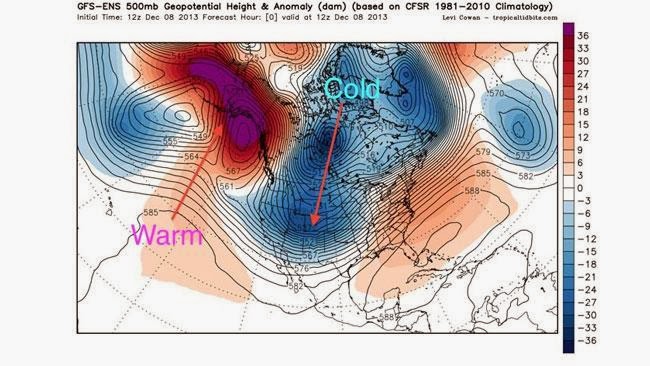
While the continental U.S. has been shivering from coast-to-coast with temperatures dropping as low as minus-40°F amid one of the most severe early December cold snaps in several years, one state bucked the trend in an historic way.
The same contorted jet stream pattern that brought the brutal cold to the lower 48 states pushed a pulse of milder-than-average air into Alaska, where some spots recorded temperatures unheard of for December.
Along Alaska's northern coastline, which lies above the Arctic Circle, the warmest December temperatures on record in at least 70 years occurred this past week.
At the airport in Deadhorse, which serves the oil production hub of Prudhoe Bay, the temperature hit 39°F on December 7, the highest December temperature on record there since at least 1968, said Rick Thoman of the National Weather Service (NWS) in Fairbanks in an interview. Even more notable, perhaps, was the fact that it was raining, rather than snowing. Rain there is unusual so late in the year.
Previously, the highest December temperature recorded at any of the two climate observation sites that have served Prudhoe Bay over the years was 35°F, set on Dec. 31, 1973, according to Chris Burt, a blogger at Weather Underground.
Thoman said it’s possible, but not likely, that other climate stations in that area — such as data collected at now defunct Cold War-era early warning radar stations — recorded slightly milder December temperatures when they were operating in the 1950s and 1960s.
December high temperature records were also set or tied at Barter Island AFB, which is a tiny airport located on a sliver of land along Alaska’s wind-whipped North Slope region, and in the small village of Wainwright, another Arctic shore location. Barter Island reached 37°F, which tied its record last set in 1973, and Wainright hit 32°F, beating the old record of 30°F last set in 2006.
Some weather stations located along the Dalton Highway south of Prudhoe Bay saw temperatures climb into the 40s, Thoman said.
Other noteworthy Alaska records included a December record high of 54°F in King Salmon, which is situated along Bristol Bay in southwest Alaska. That broke the previous record of 51°F, and records there date back to World War II. Daily high temperature records were also set at Kotzebue, Bettles, and Cold Bay, Alaska, among other locations, Thoman said.
The first nine days of December ran 22.2°F above average in Barrow, and 18.5°F above average in Kotzebue, according to NWS data.
A strong ridge of high pressure was the main cause of the record warmth in Alaska. The high shunted the jet stream, which is a high speed current of winds in the upper atmosphere, to the north of the state, while simultaneously displacing cold, Arctic air southward into Canada and the continental U.S.
Thoman said such weather patterns are not uncommon during the winter months, although the extreme nature of this one was. “This kind of thing does happen with some frequency in the cold season,” Thoman said.
“You get these amplified patterns, and the cold air’s gotta go somewhere, so you build up the ridge somewhere over the Gulf of Alaska ... pump warm air into Alaska, and on the east side of that high, that cold air is going to come plunging south.”
In recent years, studies have shown an association between extremely wavy or “amplified” jet stream patterns, with large ridges and troughs, and Arctic sea ice melt and snow cover decline during the spring and summer months. It's an active area of research, but there’s no doubt that climate change has been having profound impacts in Alaska and other areas of the Arctic region.
The 2012 Arctic Report Card depicted a region undergoing rapid and pervasive changes related to manmade global warming, including the ramifications from plummeting spring and summer sea ice cover, melting permafrost, a rapid loss of spring snow cover, and various other climate change impacts.
The 2013 edition of the Report Card, published by the National Oceanic and Atmospheric Administration, will be released on Thursday.
Recent news reports from Alaska show that increasingly mild fall seasons and erratic weather patterns have had significant effects on local communities.
For example, In Wainwright, changes in weather patterns have diminished the opportunities for subsistence hunters to safely hunt whales and caribou during the fall harvest season, according to a new study published in the journal Arctic.
Alaskans have also seen a precipitous decline in the Western Arctic Caribou Herd, which is thought to be a result, at least in part, of an increase in fall freezing rain events. A colder atmosphere used to produce more snow events, but ice storms have become more common along the caribou’s migration routes, which is helping to thin the herd, according to reporting by the Alaska Dispatch.
Although the long-term forecast calls for continued warming during the next several decades, in the near term, the high pressure area over Alaska is weakening, allowing colder air and snowier weather to return to the Frontier State, Thoman said.
The upcoming weather pattern will be “A big change from what we’ve had, that’s for sure,” Thoman said