Showing posts with label Greg boyd. Show all posts

Sunday, March 29, 2015

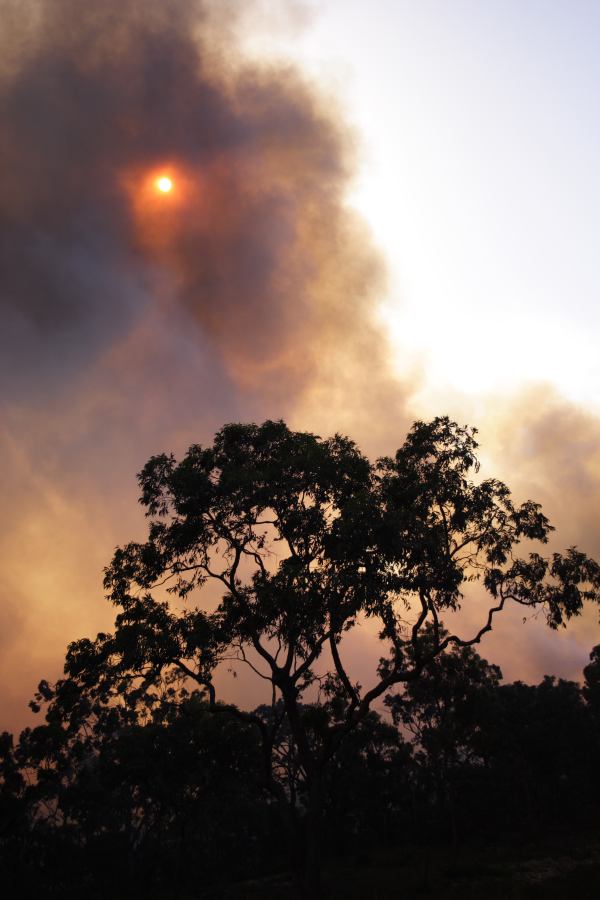
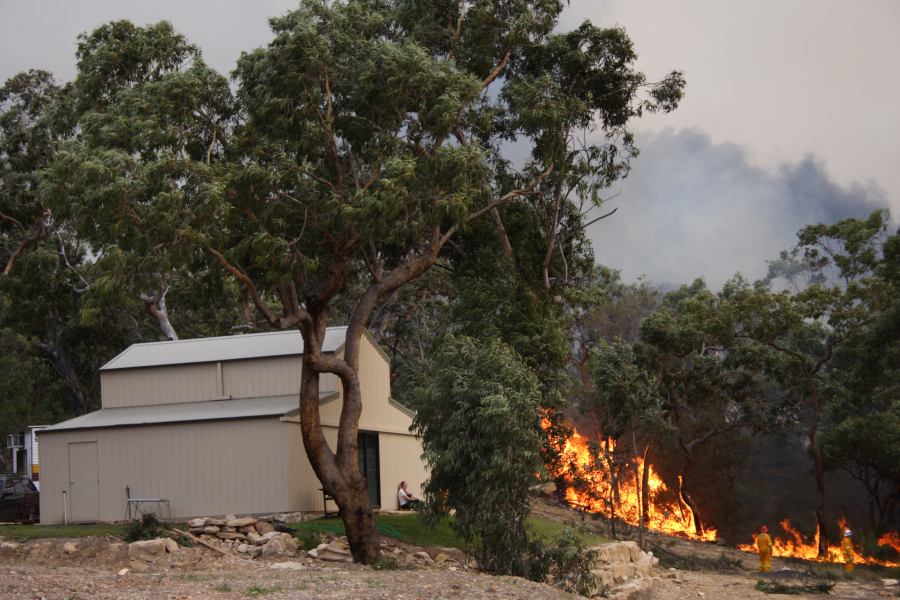
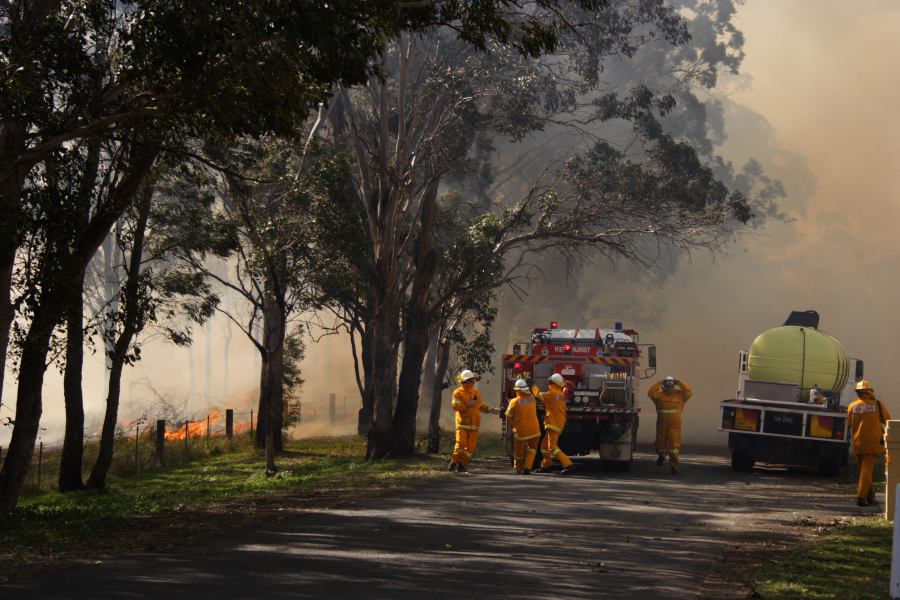
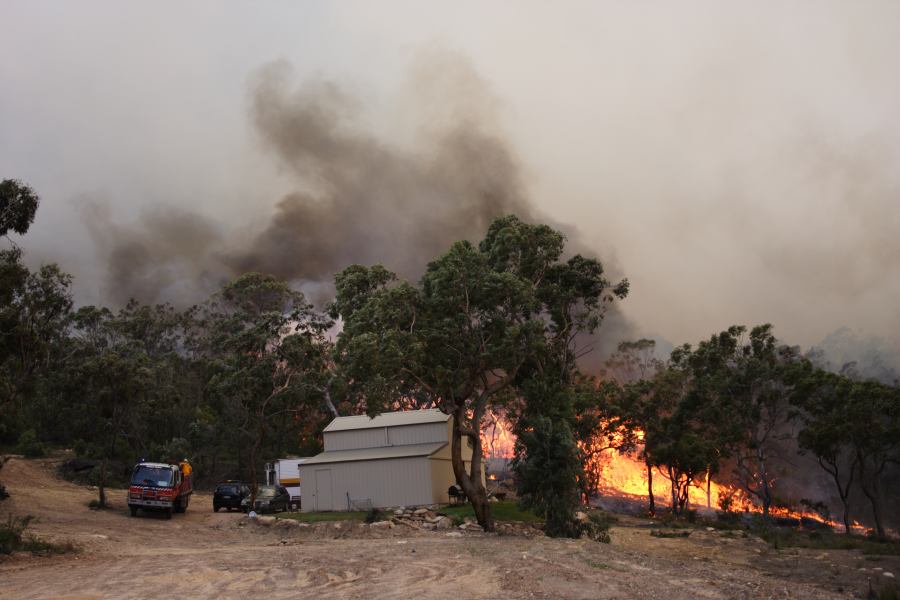
Brush Fires In Australia

Australia is known to have some of the worst Bush Fires / Wild Fires prone country in the world! Due to our extreme weather conditions it is not uncommon for us to have Wild Fires every fire season which are started by a wide variety of causes. They can be attributed to natural causes such as lightning strikes and accidental causes such as sparks from farm machinery, incinerators, power lines, vehicle crashes, escapes from burning off and camp fires. Unfortunately, a large number of bush fires are also deliberately lit.
One useful indicator that can aid forecasters and fire fighter organisations such as the NSW Rural Fire Service determine the potential for bushfires is known as the Haines Index. Simply speaking it combines the dew point depression and atmospheric stability as a means to determine the potential for fire plumes to become organised, entrain dry oxygen rich air into the fire causing explosive plumes to erupt. Also if cumulus clouds known as pyrocumulus develop above the fires, downdrafts from these plumes may create erratic winds as well as another source of oxygen rich air to descend in the vicinity of the fire. The result is the increasing efficiency for fires to spread. What the Haines Index does not take into account are amount of fuel available, wind patterns and topography. All of these factors should be considered by forecasters before determining the potential for bushfire hazards.https://www.blogger.com/blogger.g?blogID=6565483752503740244#editor/target=post;postID=1630036590336812349

Tornado Alley

Tornado Alley Chasing 2007

Although 2007 did not provide the most classic tornadic setups, for those who decided to chase were able to intercept some reasonable storms and tornadoes. In all, Jimmy Deguara intercepted several tornadic supercells with at least 7 confirmed tornadoes (and not including the massive Greensburg tornado and others still to be investigated). The supercells in some cases provided excellent photographic opportunities.
13th April 2007 - although not on the Seymour wedge tornado due to road options, the storm produced a serpentine funnel from the developing tornado. Later on approaching an HP supercell near Fort Worth dangerous giant hailstones prevented an intercept of yet another tornado.
21st April 2007 - intercepted a very large truncated tornado in southeast Colorado SE of Lamar. Extremely rapid storm scale rotation was observed with this storm wrapping rain hiding the tornado from view. Another funnel cloud was observed further north though contact on the ground could not be confirmed.https://www.blogger.com/blogger.g?blogID=6565483752503740244#editor/target=post;postID=5639136141116942788

Extreme Weather events in our future climate

Extreme weather events in our future climate

Temperatures will rise. Everything else gets complicated.

"When an extreme weather event happens, the public wants to know—is this climate change?" That statement by Lawrence Berkeley Lab's Michael Wehner provided a good background for the session on climate change and unusual weather events that happened at the meeting of the American Association for the Advancement of Science. The fact is, scientists aren't well equipped to answer that question—at least not in a way the public's likely to find satisfying.
Instead, Wehner said, science is on solid ground when it examines weather events in terms of probabilities: is the risk of a given event higher? Will the magnitude of a given type of event change?
Wehner went through some historic events and examined how climate change shifted these probabilities. For example, events similar to Europe's 2003 heat wave (which saw 70,000 deaths) are already twice as likely to occur given the amount we've warmed over pre-industrial conditions. If we allow the globe to warm by 2°C over preindustrial levels, that probability goes up to 154 times. "By the end of the century," Wehner said, "when we're likely to see 4°C warming, this event will likely seem cold."
Similar things were possible to say about the 2010 Russian heatwave (2-3 times more likely now, 5-8 times more likely at 2°C of warming) and the 2011 Texas drought (slightly elevated probability now, but up to 10 times more likely at 2°C). None of this is to say that climate change has caused any of these events; they occasionally appear in climate model runs without any added greenhouse gasses. It simply tilts the odds in their favor.https://www.blogger.com/blogger.g?blogID=6565483752503740244#editor/target=post;postID=1316121304915778836

Extreme Events

Extreme Events

Satellite view of hurricane Hugo in 1989
Extreme events such as heat waves, droughts, tornadoes, and hurricanes have affected the United States since the dawn of time. NCDC provides a variety of information detailing these events categorized by type of event.
  • U.S. Records
    This tool lists and maps records tied or broken on a given date for weather stations across the 50 United States. Records are distinguished as daily (largest/smallest for that day on the calendar), monthly (largest/smallest value during that month), or all-time (largest/smallest value ever observed at that station). Summary information for recent periods (year-to-date, month-to-date, last 30 days) is provided in tabular format.
  • Climate Extremes Index
    This index charts the occurrence of specific extreme events over time since 1910. In most cases, extreme events are defined as lying in the outermost (“most unusual”) 10 percent of a place’s history. Analyses are available at the national and regional levels.
  • U.S. Billion-Dollar Weather and Climate Disasters
    The U.S. Billion-Dollar Weather and Climate Disasters report provides readers with an aggregated loss perspective for major U.S. weather and climate events from 1980 to the present. This report provides information on direct economic losses, deaths, and other impacts for numerous weather and climate disasters including tropical cyclones, floods, droughts and heat waves, severe storms (e.g., tornadoes, hail, and straight-line winds), wildfires, crop freeze events, and winter storms. In addition to the report, interactive tools are available to better visualize the data including maps, time series, and statistical tables on the distribution of damage from these extreme events.https://www.blogger.com/blogger.g?blogID=6565483752503740244#editor/target=post;postID=3871077469176546094

Humans Cause Climate Changes

Humans Contribute to Extreme Weather – and Suffer its Consequences

Rigorous analyses have shown that natural variability alone cannot explain the observed long-term trends of changing extremes in temperature and precipitation.12
In contrast, the observed trends fit well with our understanding of how climate change drives changes in weather. Computer models of the climate that include both natural forces as well as human influences are consistent with observed global trends in heat waves, warm days and nights, and frost days over the last four decades.13 Human influence has also been shown to have contributed to the increase of heavy precipitation over the Northern Hemisphere.14
Extreme weather events do not have a single cause but instead have various possible contributing factors – and human-induced climate change is now one of those factors.
Weather variability can be extremely costly. One estimate finds that the total U.S. economic output varies by up to $485 billion/year owing to weather variability.15 From 1980 to 2010 there were 99 weather disasters in the U.S. in which damages exceeded $1 billion. Altogether those disasters cost $725 billion.16 In 2011, the costs of all weather-disaster damages so far has climbed past $35 billion, according to NOAA estimates. As of August 30th, the U.S. has witnessed 10 weather disasters costing over $1 billion each. This breaks the previous record for the number of such U.S. weather disasters in an entire year.17
Changes in extreme weather threaten human health as well as prosperity. Many societies have taken measures to cope with historical weather extremes, but new, more intense extremes have the potential to overwhelm existing human systems and structures.18 More frequent and more severe extreme weather events are more likely to destabilize ecosystems and cripple essential components of human livelihood, such as food production, transportation infrastructure, and water management. Death, disease, displacement, and economic hardship may follow, as we have seen with recent hurricanes, floods, heat waves, and droughts.https://www.blogger.com/blogger.g?blogID=6565483752503740244#editor/target=post;postID=2540031911680861164
Climate Change

A Small Increase in Average Temperature Leads to Big Changes in Extreme Weather

Small changes in the averages of many key climate variables can correspond to large changes in weather.7 Substantial changes in the frequency and intensity of extreme events can result from a relatively small shift in the average of a distribution of temperatures, precipitation, or other climate variables.8

Climate Change Shifts the Odds for Extreme Weather Events


Solomon et al. 2007
Weather variation on our planet can be described with a rough bell-shaped curve. So-called normal weather is very common while extreme weather is rare. While events close to normal occur frequently, in the broad center of the curve, there is a sharp fall-off in the frequency of events further away from normal, in the flatter ends of the curve. For instance, a small increase in temperature shifts the entire curve toward hotter high temperatures. The rarest and most extreme record heat events become even more severe and much more frequent. Precipitation does not follow quite the same pattern, but the same concept applies: fewer light and moderate rains are being replaced by more heavy rain events.https://www.blogger.com/blogger.g?blogID=6565483752503740244#editor/target=post;postID=6138147623617058261

Record Highs Now Outpace Record Lows by 2:1


The ratio of record daily high temperatures to record daily lows observed at about 1,800 weather stations in the 48 contiguous United States from January 1950 through September 2009.
Meehl et al. 2009
Recent weather events such as deadly heat waves and devastating floods have sparked popular interest in understanding the role of global warming in driving extreme weather. These events are part of a new pattern of more extreme weather across the globe, shaped in part by human-induced climate change.
As the climate has warmed, some types of extreme weather have become more frequent and severe in recent decades, with increases in extreme heat, intense precipitation, and drought. Heat waves are longer and hotter. Heavy rains and flooding are more frequent. In a wide swing between extremes, drought, too, is more intense and more widespread.https://www.climatecommunication.org/new/features/extreme-weather/overview/#!prettyPhoto/0/

European Heat wave

European 2003 Summer Temperatures Were Far Outside Normal Range


2003 European Heat Wave: The Hottest Summer in 140 Years (1864-2003). Each vertical line represents the average summer temperature for a single year from the average of four locations in Switzerland over the period 1864 through 2003. This illustrates how far outside the normal range the summer of 2003 was.
Schär et al. 2004
One way in which climate change is connected to individual events such as heat waves and heavy rains is by increasing the odds they will occur. We witness that connection in the form of more frequent extreme events. Analyzing how global warming has changed the odds for a specific event has been done for standout moments such as the European heat wave of 2003 that killed tens of thousands. Based on temperature records from 1864 to 2002, the odds of such a heatwave occurring are about 1 in 10 million.4 An event like the 2003 heatwave becomes much more likely after factoring in the observed warming of 2°F over Europe and increased weather variability.5 In addition, comparing computer models of climate with and without human contribution shows that human influence has roughly quadrupled the odds of a European summer as hot as or hotter than the summer of 2003.6https://www.blogger.com/blogger.g?blogID=6565483752503740244#editor/target=post;postID=1237956798743958554

Wednesday, March 4, 2015

Tornado in Mississippi

Tornado Hits Mississippi, Fierce Storm Moves Through Southeast


Posted: Updated:

Several tornadoes hit the Southeast on Tuesday afternoon, including one in Mississippi that left at least four dead, numerous others injured, and caused damage to structures.
Two people died in Marion County, Mississippi, and two more in Jones County, state Emergency Management Agency spokesman Brett Carr confirmed to the Huffington Post.
A tornado formed near Amite City, Louisiana and moved on to Columbia in southern Mississippi, which appeared to be hit the hardest. Striking Columbia at about 2 p.m. CT, the tornado "was a very large one," Karla Brown with the Marion County Sheriff's Department told the Huffington Post. Columbia saw extensive damage, and numerous people were injured, Carr said. The Sheriff's Department was responding to reports of people trapped.
The tornado caused power outages in Columbia and closed many roads, Carr said. A Walmart saw significant damage, WDAM reported. Jones County also saw damage to homes and power outages.
Across the southeast, at least five tornadoes touched down, in states including Mississippi, Georgia, and Louisiana, ABC reported.http://www.huffingtonpost.com/2014/12/23/mississippi-tornado-hail_n_6374470.html?utm_hp_ref=extreme-weather

tropical storm in Philippines

Tropical Storm Jangmi Kills 31 In Philippines


Posted: Updated:

MANILA, Philippines (AP) — Flash floods and landslides triggered by Tropical Storm Jangmi left at least 31 people dead and seven missing in the Philippines, including in areas still recovering from last year's Typhoon Haiyan, officials said Tuesday.
Jangmi, packing winds of 65 kilometers (40 miles) per hour and gusts of 80 kph (50 mph), dumped heavy rains Monday on southern Mindanao Island, where floods destroyed bridges and highways, sending thousands of residents to evacuation centers. The storm then pushed its way through eastern and central islands, where most of the deaths occurred Tuesday.
The government weather bureau said that as of late Tuesday afternoon, the eye of the storm was 140 kilometers (87 miles) southwest of central Iloilo City, moving west at 19 kph (12 mph) toward western Palawan Island.http://www.huffingtonpost.com/2014/12/30/tropical-storm-jangmi-philippines_n_6394724.html?utm_hp_ref=extreme-weather

flying in tornados vs flyng in a hurricane

hurricane
“Thunderstorms are sort of the grandaddy of all aviation hazards because they sort of contain it all,” Dr. Bruce Carmichael, who runs the Aviation Applications Program at the National Center for Atmospheric Research, told Wired. “Turbulence, severe structural icing, engine icing, loss of visibility, lightning, wind shear, extreme updrafts and downdrafts. So virtually any hazard to aviation you can imagine.”
Hurricane flights, in contrast, are “fairly boring,” according to the National Oceanic and Atmospheric Administration (NOAA). “They last 10 hours, there are clouds above you and clouds below -- so all you see is gray, and you don't feel the winds swirling around the hurricane.”
According to the Hurricane Hunters of the U.S. Air Force Reserve, aircrews that conducts flights into hurricanes to collect data, there are typically only a “few ‘exciting’ moments” during a hurricane flight -- and they occur when the plane enters the eye wall area of a hurricane, which is a donut-like ring of thunderstorms around the hurricane's calm eye where the most intense rainfall and damaging winds are found.http://www.huffingtonpost.com/2015/02/18/fly-into-hurricane-thunderstorm-video_n_6702996.html?utm_hp_ref=extreme-weather

Cyclone Marcia

Cyclone Marcia has intensified to a powerful category five storm, with wind gusts up to 295km/h, as it continues to head towards the Queensland coast
Severe tropical cyclone Marcia - live blog
Cyclone Marcia
Cyclone Marcia is expected to hit the eastern coast of Queensland on Friday, with gusts of up to 295 km/h. Photograph: AP
Cyclone Marcia has intensified to a powerful category five storm, with wind gusts up to 295km/h, as it continues to head towards the Queensland coast.
The storm is expected to make landfall as a category five system, between St Lawrence and Hervey Bay around 10am AEST on Friday.
Marcia has not done as emergency services had hoped and come straight in on the central Queensland coast. Instead it has tracked south, allowing it to stay over the sea and continue to build in strength.
The power of the cyclone has even forced the closure of a cyclone shelter at St Lawrence, amid fears it would not withstand the storm.
About 90 residents who had been taking shelter there have moved north to take shelter at nearby Sarina.http://www.theguardian.com/australia-news/2015/feb/19/cyclone-marcia-set-to-hit-queensland-as-a-category-five-storm

Sunday, February 22, 2015

Floods in Africa 2015

Malawi floods devastation far worse than first thought
UN agencies scale up response to disaster that has displaced nearly a quarter of a million people, and threatens disease and malnutrition
People cross a river with their belongings where a bridge once stood in Phaloni, southern Malawi, on 22 January.
People cross a river with their belongings where a bridge once stood in Phaloni, southern Malawi, on 22 January. Heavy rains and floods have displaced 230,000 people in the southeastern African country. Photograph: Shiraaz Mohamed/AP
The UN children’s agency, Unicef, said new figures from the UN and the government of Malawi showed the number of people displaced stood at 230,000, compared with an original estimate of 174,000. About 64,000 hectares (158,147 acres) of land were damaged, it added.
The scale of the disaster has wreaked havoc on the densely populated country, where most people survive from subsistence farming. Crops of maize have been destroyed, villages obliterated, homes swept away and livestock killed.
In mid-January, President Peter Mutharika declared half the country a disaster zone and estimated it would cost 23.9bn kwacha ($51m) to repair the damage.
Unicef said 276 people had been killed or were missing, while 645 people had been injured.

Heavy Rain in Hawaii


recent study by University of Hawai'i at Mānoa researchers determined that heavy rainfall events have become more frequent over the last 50 years on Hawai'i Island. For instance, a rare storm with daily precipitation of nearly 12 inches, occurring once every 20 years by 1960, has become a rather common storm event on the Big Island of Hawai'i -- returning every 3-5 years by 2009.

While heavy rainfall events have become more frequent over the last 50 years on the easternmost island in Hawai'i, the opposite behavior is observed for Oʻahu and Maui to the west. There, rainfall extremes have become less frequent in the last five decades. This study, therefore, also reveals a regional -- that is, east to west -- difference in how precipitation patterns are responding to a changing climate.


http://www.sciencedaily.com/releases/2015/02/150205095237.htm

Thursday, February 12, 2015

The coldest Temperature ever recorded


anarcticaREUTERS/NASAAn aerial view of a crack at the Pine Island Glacier ice shelf is seen in western Antarctica, October 26, 2011.


Read more: http://www.businessinsider.com/the-coldest-temperature-ever-recorded-is-1358-f-2013-12#ixzz3RZNeAjAU

Perhaps you've noticed it's gotten cold outside. Even California is in the midst of a cold front.
It's not just you, it's the Earth. Newly analyzed satellite data shows a record low for the planet has been recorded.
The coldest temperature was actually recorded two years ago, on August 20 2010. That day, Antarctica's temperature fell to  -135.8F or  -94.7C. That's almost 10 degrees colder than the previous record.


Read more: http://www.businessinsider.com/the-coldest-temperature-ever-recorded-is-1358-f-2013-12#ixzz3RZNkoQZS

Rain Forests and the Climate

Amazon rainforest losing ability to regulate climate, scientist warns
Report says logging and burning of Amazon might be connected to worsening droughts – such as the one plaguing São Paulo
amazonin
Smoke billows as an area of the Amazon rainforest is burned to clear land for agriculture near Novo Progresso, Para State. Photograph: Nacho Doce/Reuters
The Amazon rainforest has degraded to the point where it is losing its ability to benignly regulate weather systems, according to a stark new warning from one of Brazil’s leading scientists.
In a new report, Antonio Nobre, researcher in the government’s space institute, Earth System Science Centre, says the logging and burning of the world’s greatest forest might be connected to worsening droughts – such as the one currently plaguing São Paulo – and is likely to lead eventually to more extreme weather events.http://www.theguardian.com/environment/2014/oct/31/amazon-rainforest-deforestation-weather-droughts-report

Weather Averages across the US

February Extreme Weather/Climate Events

Wednesday, February 11, 2015

Global Warming Effects in Alaska


1 of 9


An arch made from Bowhead whale bones lies June 4, 2006 in Browerville, Alaska. Scientists continue to study changes in the Earth's climate which many attribute to the emission of greenhouse gases. (Justin Sullivan/Getty Images)   www.weather.com/science/news/2014-world-extreme-weather-events-2014

Recent Hurricanes with Damages exceeding $1 Billion


Hurricane Table

 How can we prepare for future hurricanes and reduce the risk?
  • Reduce global warming pollution to minimize future hurricane risk.
  • Restore and increase protection for coastal wetlands, lowlands, and barrier islands.
  • Take global warming into account when choosing where to build.
  • Take global warming into account when choosing how to build.


www.nwf.org/.../Global-Warming/Global-Warming-is-Causing-Extreme-Weather

Monday, February 9, 2015

Severe water levels in California

Heat waves and cold snaps, hurricanes and tornadoes, downpours and blizzards — they form the extreme ends of the weather spectrum, affecting our health, infrastructure and livelihoods. And as manmade greenhouse gases are steadily boosting the Earth’s temperature, the nagging question becomes, is global warming to blame? And then, is there more extreme weather in our future?
The severely diminshed water levels of California's Lake Shasta.
Credit: Lyle Rains/flickr

In 2014, researchers were able to make firm connections between climate change and some extreme weather events, and have begun to include new types of weather in those attributions. Those efforts are likely to gain steam in 2015, bringing the links between weather and climate into clearer focus.
The easiest parallel to draw between extreme weather and climate change has been, not surprisingly, heat. That doesn’t mean just the sweaty, sticky summer days that send you gasping for air conditioning. The overall warming of the atmosphere has made heat records more likely over the span of years, including 2014, both locally and globally.https://climatecentral.org/news