Thursday, October 2, 2014

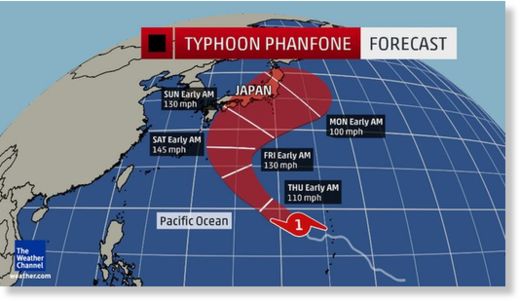
Typhoon Phanfone Threatens Japan, Tokyo This Weekend


Phanfone strengthened from a Category 1 equivalent typhoon (75 mph estimated max winds) early Wednesday evening, local time (Japan is 13 hours ahead of U.S. EDT) to a Category 4 equivalenttyphoon (130 mph estimated max winds) early Thursday evening, local time, a jump of 55 mph (or 50 knots) in 24 hours.
"Phanfone had the dreaded pinhole eye rarely seen in tropical cyclones," said The Weather Channel hurricane specialist Michael Lowry. "The eye was so small even our best microwave satellites have trouble seeing it."
Typhoon Phanfone will continue to be in a favorable environment of low wind shear and high sea-surface temperatures through Friday. Therefore, additional strengthening is possible, possibly to super typhoon status (150 mph max sustained winds) for a brief time.
It should be noted intense tropical cyclones often go through eyewall replacement cycles, where a new outer eyewall cuts off, then replaces the old, inner eyewall. Tropical cyclones typically weaken a bit during this process, and the timing of these cycles is not able to be forecast using current technology.
Regardless of all that, the forecast track of this intense typhoon is critical.

35,000 Walrus Come Ashore in Alaska As Sea Ice Retreats

Global warming continues to have a major effect on our planet and the various species that exist within it. About 35,000 Pacific walruses were seen gathered on the shores of Alaska on September 23rd. Recently, experts have stated that the direct cause of this event was triggered by the loss of sea ice in the Arctic. When walruses hunt and cannot find food, they rely on sea ice to rest. However, the retreatment of sea ice posed a threat to their survival so the walruses were forced to find shelter on the shores of Alaska. Lou Lenard, vice president for climate change at the World Wildlife Fund states "We are witnessing a slow-motion catastrophe in the Arctic. As this ice dwindles, the Arctic will experience some of the most dramatic changes our generation has ever witnessed. This loss will impact the annual migration of wildlife through the region, threaten the long-term health of walrus and polar bear populations, and change the lives of those who rely on the Arctic ecosystem for their way of life." It is reported that the Arctic ice coverage reached its lowest point on September 17th, the sixth lowest record since the beginning of Arctic ice coverage records in 1979. Some scientists are skeptical about the direct cause of this phenomena, stating that this is not the first time we have seen walruses gathered in such mass numbers. Scientists will continue to investigate this incident, since it proves to be a major concern among the scientific community.

In this aerial photo taken on Sept. 23, 2014 and released by NOAA, some 1500 walrus are gather on the northwest coast of Alaska.

Link: http://www.wunderground.com/news/alaska-walrus-photos-20141002?

Strong Storms and High Winds Causes Power Outage In Texas

At least 120,000 people living in the northern Texas area are experiencing a power outage due to a series of severe thunderstorms moving along the northern Texas area and into Oklahoma. The storms were able to produce hail the size of baseballs with winds reaching up to 70 miles per hour. The storms are said to be moving in the direction of the Dallas/Fort Worth metro areas. There has already been evidence of some major damage as a result of these storms. The storms had a major effect on the Fort Worth Stockyards, a popular tourist area attraction in Texas. A wall was said to be destroyed while its piles of bricks crushed several vehicles. The University of North Texas Health Science Center lost its revolving door due to the high winds that they were experiencing. In the Arlington area, trees were blown down and a high school had even lost its roof. There is a growing concern over the safety of the people, police are now clearing crowds at the State Fair of Texas because the storms are moving in on them.


Link: http://www.wunderground.com/news/texas-oklahoma-arkansas-severe-weather-20141002?

Earthquake Rattles States

A 4.4-magnitude earthquake rattled a large part of Kansas and Oklahoma Thursday afternoon, just one day after residents had been ducking for cover from tornado warnings and severe thunderstorms.
The U.S. Geological Survey said the quake struck at 1:01 p.m. CDT. The epicenter was 7 miles east-southeast of Harper, Kansas, or about 43 miles southwest of Wichita, Kansas. There have been no immediate reports of damage. Wichita television station KAKE-TV said officials near the epicenter in Harper County, Kansas, reported no known damage.
Shaking was felt in Wichita as well as in Oklahoma City and Tulsa, Oklahoma; the latter is some 135 miles from the epicenter. One local television meteorologist in Tulsa dubbed it a "thunderquake" due to thunderstorms occurring at the same time:
Twitter traffic and the USGS's "Did You Feel It?" Web page indicated that the quake was felt as far away as Manhattan and Lawrence, Kansas.
The USGS reported an apparent aftershock registering a magnitude of 3.4 in the same area at 1:35 p.m. CDT. Reports to the USGS indicate it was only felt by residents of rural areas close to the epicenter.
Hundreds of earthquakes, most of them minor, have occurred in Oklahoma over the past few years; scientists believe wastewater disposal related to natural gas extraction may be inducing the activity.
Thursday's quake, however, was centered over southern Kansas. While its magnitude of 4.4 may be revised as seismologists review more data, it currently ties an Aug. 19 temblor near Guthrie, Oklahoma, as the strongest of 2014 in this region of the country.


http://www.wunderground.com/news/wichita-tulsa-earthquake-kansas-oklahoma-20141002

Record Rainfall in France

It is hard to believe that another rainstorm of equal intensity to that which I blogged about just 11 days ago has again struck the Languedoc Region of Southern France. This time the focus of the storm was centered over the city of Montpellier, Herault District, near the Mediterranean Coast. Montpellier, a city of some 240,000, was deluged with an all-time 24-hour record 299 mm (11.77”) of rainfall between 8 a.m September 29th and 8 a.m. (local time) September 30th. 

This is the equivalent of almost four times the average monthly precipitation for September in the city. Its previous 24-hour rainfall record for September was 187 mm (7.36”) on September 22, 2003 and its all-time record 205 mm (8.07" on October 25, 1979. Some private weather stations in Montpellier reported totals of up to 325 mm (12.80”) according to a German weather forum monitored by Michael Theusner of Klimahaus in Bremerhaven, Germany. 


Arctic's Sea Ice Affecting Food Source

The Arctic's shrinking sea ice is reshaping the region's food web from the bottom up, a new study reports.
Historically, tiny plantlike organisms called phytoplankton burst into bloom in the spring in the Arctic Ocean. The enormous one- to two-week bloom sets off a feeding frenzy among zooplankton, fish and bottom-dwelling creatures at the base of the Arctic food chain.
"The entire ocean system is linked to this massive input of carbon," said lead study author Mathieu Ardyna, a marine biologist at Laval University's Takuvik Joint International Laboratory in Quebec, Canada.  But now, because of the declining sea ice, a second bloom also appears in the fall, according to a new analysis of satellite records, published Sept. 2 in the journal Geophysical Research Letters. The fall bloom could have widespread ripple effects on marine life and the Arctic climate. Phytoplankton clear carbon dioxide from the atmosphere through photosynthesis.


Wednesday, October 1, 2014

Japan's Mount Ontake Volcano: Death Toll Rises to 48; Ash Continues to Spew


The death toll from Saturday's eruption of the Japanese volcano Mount Ontake rose yet again Wednesday after another dozen bodies were discovered on the mountain.
That raises the total to 48 confirmed deaths from the eruption as search crews continued to work despite ash and smoke still seeping from the crater. Nagano police said the searchers were carrying devices that measured the toxicity of the ash to ensure it was safe to be on the slopes.
Before Saturday, seismologists had detected signs of increased seismic activity at Mount Ontake, one of Japan's 110 active volcanos, but nothing signaled a fatal eruption.
Survivors said huge boulders fell from the sky and billowing gray smoke cast total darkness over the mountain minutes after the eruption. Their stories indicated that those who managed to hide behind big rocks or escaped into nearby lodges survived.

Link: http://www.wunderground.com/news/japan-mount-ontake-eruption-20141001