Showing posts with label Colleen O'Toole. Show all posts

Saturday, April 25, 2015

New Jersey Houses Dangerously Close to Sliding Into River; Residents Forced to Evacuate

New Jersey officials ordered two groups of homeowners to evacuate Wednesday citing the risk of their homes sliding into the Delaware River.
Over the last few days, heavy rainfall has exacerbated preexisting erosion in Florence, New Jersey, and toppled a large tree into the river 70 feet below the homes.
Enlarge

A large landslide is seen between two homes overlooking the Delaware River Wednesday, April 22, 2015, in Florence, N.J. (AP Photo/Mel Evans )
According to township administrator Richard Brook, the evacuation might be permanent.

(MORE: Melting Ice Reveals Lake Michigan Shipwrecks)
"It would be too unsafe for them," Brook said Wednesday. "It can only deteriorate. It can't get better without man-made help."
Chris O'Dell, who has owned one of the homes for more than a decade, said he realized that, too. "When we walk away, we could be walking away for good and losing everything," he said. "That's hard to take."
His wife, Lynne O'Dell, cried as she spoke. "This is our home," she said. "We put a lot of effort into it. I put a lot of love in this house."
Brook said he believes that an abandoned storm sewer running through the properties was a factor in the ground becoming unstable. He said it is being resealed to try to prevent more water from rushing through.
A Burlington County spokesman said the county engineer is trying to determine what caused the erosion and whether it can be stopped.
Officials said homeowners would be allowed to move things out of the homes but could not stay there overnight.
Brook also said the local government does not want anyone else going near the site.

http://www.weather.com/news/news/new-jersey-landslide-risk-delaware-river

Ensenada, Chile, 'Ghost Town' After Twin Volcanic Eruptions Blanket Area in Ash

Two eruptions blasted forth from Chile's Calbuco volcano for the first time in more than 42 years on Wednesday, creating a remarkable scene of smoke plumes and ash shooting more than 6 miles into the sky. Calbuco had another spectacular outburst early Thursday with lightning crackling through a dark sky turned reddish orange by the explosion.
Ensenada, in the foothills of the volcano, looked like a ghost town Thursday, but for an occasional horse or dog roaming its only street. Most of the 1,500 residents had evacuated after the initial eruption Wednesday, with only about 30 people refusing to leave out of worry for their homes and animals, The Associated Press reported.
The height of the volcanic ash emitted triggered concerns that the dust could contaminate water, trigger respiratory illnesses and halt more flights. No injuries have been reported.
The first blast surprised Chilean emergency officials, who were left with only minutes to issue an alert.
"People went into a state of panic," said Miguel Silva Diaz, an engineer who lives in Puerto Montt, a city about 14 miles from the volcano. "Then, at around 1 a.m., I heard a loud noise, as if somebody had detonated an atomic bomb."
Parts of Argentina reported heavy ash falling after the eruption. According to analysis by Argentina's meteorological service, the ash cloud was shot as high as 40,000 feet
 
http://www.weather.com/news/news/chile-calbuco-volcano-eruption-evacuations-alerts

Nepal Earthquake Kills At Least 688; 7.8-Magnitude Temblor Worst To Hit Country in 80 Years

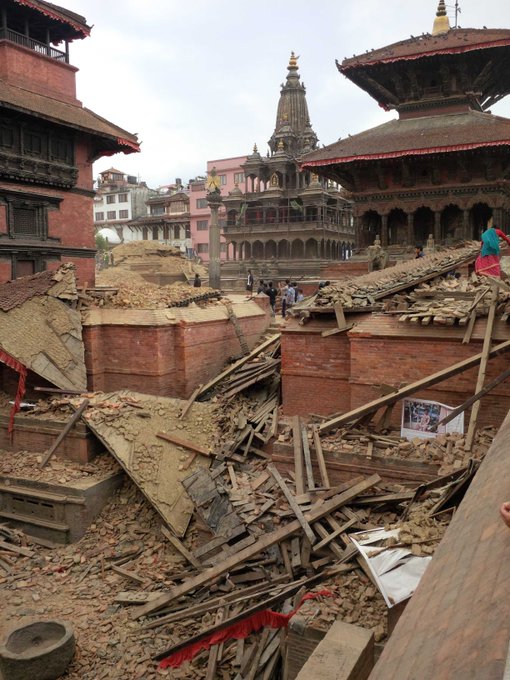
At least 688 people are dead after a massive 7.8-magnitude earthquake rocked Nepal Saturday, which collapsed homes and brought down centuries-old temples while triggering avalanches in the Himalayas. It was the worst earthquake to strike the country in more than 80 years.
The temblor shook the poor South Asian nation before noon and the most intense effects were felt in the capital, Kathmandu, as well as the densely populated Kathmandu Valley. Several powerful aftershocks were felt in the hours following the main quake.
The Home Ministry confirmed that among the deaths, two Chinese citizens were killed on the border, as well as 20 people in India, two in Bangladesh and six in Tibet. At the main hospital in Kathmandu, dozens of injured residents poured into the building, desperately needing treatment.

View image on Twitter

A Final Look Inside One of Nature's Most Mesmerizing Places

This is as close as you’ll ever get to seeing inside this ice cave on Oregon’s Mount Hood — because it no longer exists.
These photos from Josh Hydeman are believed to be the last ones taken inside the cave on the Sandy Glacier before it collapsed at the end of January 2015.
This cave, along with two others that did not collapse, were first discovered in 2010.
(PHOTOS: 100 Feet of Snow In One Day?)
Caves like this are formed over time by surface water melting away the ice through a vertical shaft. But as weather.com's Matt Sampson explains, warming temperatures made them unstable, and Hydeman had to proceed very carefully with three other daredevil explorers.

http://www.weather.com/science/nature/news/last-photos-in-ice-cave-josh-hydeman

Death Valley Flowers in Bloom Sums Up a Crazy Winter in One Photo

While the East Coast waits for the flowers and trees to bloom at the end of a long winter, one place that hasn't had any issues with blooming vegetation might surprise you.
Death Valley has experienced a warmer-than-average winter and enough rain to allow for wildflower growth at the national park, according to the Death Valley Natural History Association. The group posted photos of the widespread bloom, and Thursday, the Las Vegas office of the National Weather Service followed by tweeting the image at the top of this page.
Although wildflowers do bloom in the harsh climate, experts say this year's color is coming out sooner and could be more plentiful.
"The weather over the next several weeks will be the determining factor but from what I'm seeing on the ground, this could be the best year we've had since the spectacular displays of 2005," said DVNHA executive director David Blacker in a statement, according to a February report by the Los Angeles Times.

Thousands of Dead Sea Sinkholes Open Up, Worrying Officials

The Dead Sea has been losing water for years, but it's a side effect of that evaporation that has experts especially worried.
Over the last three decades, more than 3,000 sinkholes have opened up in dry parts of the ever-shrinking Dead Sea, according to ABC News. They're developing at all times of the day and night, experts say, and they're starting to affect roadways that run alongside the water.
An article by Smithsonian Magazine in 2005 said there had been about 1,000 sinkholes reported to that point, so the pace at which these holes are forming seems to be accelerating.
(PHOTOS: Strongest Solar Storm Since 2013 Hits Earth)
"It's nature's revenge," Gidon Bromberg, the Israeli Director at EcoPeace Middle East, told ABC News. "These sinkholes are a direct result of the inappropriate mismanagement of water resources in the region."
Bromberg said there have been so many sinkholes, some are forming close enough to other sinkholes to merge, leading to an even bigger crater in the Earth.
http://www.weather.com/science/nature/news/dead-sea-sinkholes

Ohio River Flooding Visible from Space, NASA Satellites Show

This year's spring thaw sent the Ohio River to its highest levels in nearly two decades after torrential rains and melting snow soaked the valley. The GIF above shows two satellite images taken a year apart, and you can see the difference.
Last week, the river crested at 57.7 feet, a level unseen since 1997, which led to five homes flooding in New Richmond, which sits along the north bank of the river in southeast Ohio.
(MORE: Flooding in the Ohio River Valley)
The GIF above is made of two images from NASA's Aqua satellite, taken one year apart.
When you compare the two images, which capture 260 miles worth of the Ohio River Valley, the significance of the flooding becomes clear.
In the Northeast, where several states remain layered in snow, similar flooding could occur if spring's rising temperatures melt the snowpack quickly.

Strong Winds Push Billions of Velella Velella Jellyfish onto the West Coast

Strong winds and above average sea surface temperatures are killing off this unusual animal in large numbers.
Known as "purple sailors," billions of velella velella jellyfish have been carried onto multiple shorelines across the West Coast by powerful surface winds.
"Since March, the component of surface wind blowing from west to east over the northeast Pacific toward coastal Washington and northwest Oregon has been stronger than average," said weather.com meteorologist Jonathan Erdman.
Enlarge

(Golden Gate National Parks Conservancy )
The indigo-colored jellyfish are famous for their small dorsal sails, which normally keep them out to sea eating plankton.

(MORE: Japan Tsunami Boat Found off Oregon)
After the winter, as sea surface temperatures rise, the jellyfish migrate closer to the shore in droves. Poised next to the beach, velella velella are powerless to avoid being carried onto shore by strong winds and turbulent thunderstorms.
Once they wash up, in the thousands on a single beach as the Oregonian reports, the sea creatures die.
Luckily for beach goers, velella velella aren't poisonous to the touch and won't sting, but scientists at Oregon State University say to avoid the jellyfish because they carry a mild neurotoxin.
Recently climate scientists identified a warm water "blob: disrupting marine life off the West Coast and affecting U.S. weather systems.

http://www.weather.com/science/nature/news/velella-jellyfish-west-coast-wind

Tuesday, April 21, 2015

Russia Wildfire Smoke Reaches California, Oregon and Washington

Smoke from wildfires thousands of miles away in Russia reached the U.S. West Coast this past weekend (April 17-19). 
Strong winds fanned agricultural fires in Siberia on April 12 that eventually got out of control. At least 23 people were killed and more than 1,000 homes were damaged or destroyed in southern Siberia.
In the first three images above you can see how satellites sensed the aerosols associated with the smoke as winds aloft transported them from eastern Russia to the north Pacific Ocean April 15-17. The blue, green, yellow and orange shadings illustrate where the aerosols were concentrated each day as they spread east.
The smoke reached Washington on April 17, as shown by the hazy conditions in the fifth image. Hazy skies were observed by residents of western Washington that day, as the National Weather Service in Seattle noted in this tweet.


http://www.weather.com/science/environment/news/russia-wildfires-smoke-reaches-california-oregon-washington

Mass Dolphin Beaching Sparks Earthquake Fears in Japan


A devastating mass beaching of electra dolphins in Japan has triggered fears that an earthquake could be imminent.
The Japan Times reports that beachgoers on the coast of Hokota, north of Tokyo, started to find dozens of the dolphins' corpses washed up last Friday.
Enlarge

Children look at stranded dolphins at the shore in Hokota, north of Tokyo.  (AP Photo/Kyodo News)
    Officials worked to save the stranded dolphins, but were able to save only three of the nearly 150 that washed ashore. 
    “Many people volunteered to rescue them but the dolphins became very, very weak. … Only three of them have been successfully returned to the sea, as far as we can confirm,” a Hokota city official said. 
    Six days before the catastrophic 2011 tsunami, there was a mass beaching of the same species in Japan, leading some to speculate that this latest beaching will be the precursor to an earthquake offshore. 
    Scientists, however, are not convinced of this explanation. In fact, they explain that it might be an issue with the animals' sonar. 
    Al Jazeera America reports that one explanation for the group beaching was that the dolphins became disoriented and lost their sense of direction

    http://www.weather.com/science/nature/news/japan-dolphin-beaching-earthquake-fears

    Australia Storm Hammers Sydney, New South Wales; Flooding Washes Away Homes


    A slow-moving storm has hammered parts of eastern Australia's New South Wales province with damaging winds and destructive flooding.
    The BBC reported that three people were found dead in the town of Dungog. Homes were swept away as over 12 inches (312 millimeters) of rain in just 24 hours swamped the town of about 2,100 residents 135 miles north of Sydney, according to the Australian Bureau of Meteorology (BoM).
    New South Wales Fire and Rescue ushered four people trapped in a flooded home and local government urged residents of Dungog to evacuate to a local high school, if possible, due to the severe flooding.
    Numerous locations near the coast in New South Wales picked up another 100 millimeters – just less than 4 inches – of rain since 9 a.m. local time Tuesday, on top of heavy rainfall from Monday. The BoM continued flood warnings for stretches of eight rivers in the province, including the Williams River near Dungog.

    http://www.weather.com/news/news/australia-storm-sydney-new-south-wales-flooding

    Cyclone Pam Flattens Vanuatu: Rescue Teams Report Devastation; Official Death Toll Lowered

    Rescue teams and relief workers made their way to Vanuatu's outer islands Tuesday after struggling to reach the devastated archipelago's worst-hit areas. 
    Aid from Australia and New Zealand is welcomed as Vanuatu's residents say they're running out of vital supplies.
    "We are running short of food, water, shelter and electricity," resident Ropate Vuso told Reuters. 
    This weekend, cyclone Pam lashed Vanuatu and caused widespread damage. With communications down and the islands in a scramble, officials were unable to gather accurate information. 
    A death count from the U.N. was lowered to 11 from 24 Tuesday after officials realized they counted someone people twice, the Associated Press reports. 
    At least 3,300 people in Vanuatu were left homeless Monday as aid began to arrive from nearby Australia and New Zealand, the U.N. confirmed. 
    In Vanuatu's capital Port Vila, Oxfam Australia says that up to 90% of housing has been damaged, including vital supplies of food and water.


    View image on Twitter
    utter devastation in Port vila

    Tornado Strikes Brazil, Killing at Least Two People and Leaving More Than 1,000 Homeless

    A tornado struck the town of Xanxerê in the southern Brazil state of Santa Catarina on Monday, killing at least two people and leaving more than 1,000 homeless, according to The Associated Press. In addition to the deaths, globo.com says that more than 100 people were injured.
    Photos and video from social media showed cars flipped over and significant damage to buildings. The state of Santa Catarina's civil defense department said Tuesday that 500 homes were damaged.

    Aerial photo of the damage in Xanxerê, Brazil.  (Corpo de Bombeiros Militar de Santa Catarina)
      Meteorologist Mamedes Luiz Melo of Inmet Brasilia told globo.com that based on the photos available, the damage rating estimate for the tornado is between F2 and F3.
      According to a paper published by scientists at Universidade Estadual de Campinas (UNICAMP), tornadoes are most common in the southern part of Brazil where the city of Xanxerê is located. From 1991 to 2010, Brazil saw most of its tornadoes from September through May, which coincides with spring, summer and fall in the Southern Hemisphere.


      The Enhanced Fujita Scale: How Tornadoes are Rated


      The Enhanced Fujita Scale: How Tornadoes are Rated

      Practically speaking, it is nearly impossible to measure the actual wind speed inside tornadoes, as they can destroy just about any unprotected weather instruments placed in their path. While ingenious storm chasers and engineers have devised vehicles and instrument packs that can withstand a tornado, the logistics and time involved to deploy such devices before every tornado would be inconceivable.
      This is why a measurement system for estimating the intensity of tornadoes after their impact was devised, a system known today as the Enhanced Fujita Tornado Intensity Scale.


      Enhanced Fujita Scale: EF-2 Tornado Damage
      4 of 7

      Tuesday, February 17, 2015

      Drought Unveils Brazilian Town Unseen for over 45 Years

      Brazil's worst drought in 80 years has brought a town back to life, but not how you would expect. 
      In 1969, the Brazilian government dammed the Jaguari River near Sao Paulo and flooded Igarata, Reuters says. 


        Over four decades later, as the Jaguari River has dropped to 98 feet below its normal levels, remnants of the town are popping out of the water. 
        Bricks, ruined buildings, trees and old benches are resurfacing and kindling nostalgia. 
        Former Igarata resident Irene De Almedia is conflicted by the resurgance. 
        "It brings me happiness in some ways, but it's also very sad," Jose Almedia told Reuters. "Happiness because the things that were around when I was a child are re-emerging from the water, but sadness because of the lack of water."

        Underwater Volcanoes Linked to Climate Change in New Study

        Underwater volcanoes could have a long-term effect on Earth's climate cycles.
        A new study out of Columbia University shows that these hidden giants are not only tied to the Earth's orbit and tidal cycles, but also trigger climate swings. 
        “People have ignored seafloor volcanoes on the idea that their influence is small—but that’s because they are assumed to be in a steady state, which they’re not,” marine geophysicist Maya Tolstoy, the study's author, said in a statement. 
        The study, published recently in the journal Geophysical Research Letters, shows that underwater volcanoes defy expectations and erupt in bursts rather than a slow pace
        But that's not all. 
        Analyzing 25 years of seismic data from submarine volcanoes, Tolstoy and her team found that underwater volcanism affects the climate by emitting varying levels of carbon dioxide into the atmosphere. Higher levels of carbon dioxide in the atmosphere, then, could trigger a cycle of global warming. 
        While the link between marine volcanism and global climate cycles is not definite, the study opens the way for other scientists to explore the relationship between the Earth's crust and the ozone layer. 


        3 of 53

        Global Cooling, on Purpose? Federal Report Suggests Drastic Measures For Fighting Climate Change

        In what was once considered a fringe idea to alter the weather conditions of our planet, a federal report was released Tuesday suggesting it might be time to take desperate measures to reverse the effects of climate change.
        The two-volume report released by the National Academy of Sciences posed the idea of injecting sulfur pollution into the upper levels of the atmosphere to reflect the sun's heat away from the planet. Though the report stopped short of suggesting this method be immediately used, it said scientists should study and possibly test the idea soon to help keep global temperatures from rising out of control.
        The injections would mimic the effects of a large volcanic eruption, which tend to have a cooling effect on the atmosphere, the report said. While it's believed this would be a relatively cheap and effective way to halt the progression of climate change, scientists are still worried that it could have dangerous, unintended side effects that they're not aware of just yet.


        Megadroughts the Future of the U.S., NASA Study Says

        The United States will likely experience 'megadroughts' the magnitude of which haven't been experienced in a millennium, due in large part to man-made climate change, a new study conducted by NASA, Columbia University and Cornell University scientists said. 
        The study analyzed climate models and tree ring records in portions of at least 16 states and found that global temperature rise due to man-made climate change, and not a lack of precipitation, could increase the chance of the West and Southwest experiencing a megadrought -- a  severe drought lasting decades -- by the year 2100 to more than 80 percent, National Geographic reports.  
        "This is an amazing result ... The precipitation is not so dire. It is the escalation in temperature that is driving the model simulations toward dramatic aridity, " David Stahle, a paleoclimatologist at the University of Arkansas points out to LiveScience.com.