Showing posts with label Ryland Wimberly. Show all posts

Wednesday, October 25, 2017

Death Star


Tethys
An an image just released by NASA, Saturn's moon bears a striking but totally-not-disconcerting resemblance to a famous piece of sci-fi weaponry: The Death Star, a planet-killing behemoth recently brought back to life in "The Force Awakens". Insert your Star Wars joke of choice here. Rinse. Repeat.
 
This "that's no moon!" moon is Tethys, a 660-mile-wide satellite of Saturn made mostly of water ice. Its icy composition is what gives it such a spacecraft-like sheen (the only brighter moon in Saturn's orbit is Enceladus, which is covered in an ocean topped with pristine ice, and it's one of the most reflective objects in the solar system).

But the feature that makes Tethys really Death-Star-y is the huge honking crater on its surface. Dubbed Odysseus, the pock mark is one of the largest craters in the entire solar system. The rebound of whatever large object formed Odysseus produced some high mountains in the crater's center, and they just happen to correspond to that little nubbin in the center of the Death Star's, um, laser-y bit. Anyway, it's uncanny! Alderaan better watch out.
 https://www.popsci.com/tethys-saturn-moon-death-star

Thursday, October 19, 2017

Solar Evaportation Ponds


An astronaut aboard the International Space Station took this photograph of solar evaporation ponds outside the city of Moab, Utah. There are 23 colorful ponds spread across 400 acres. They are part of a large operation to mine potassium chloride—more commonly referred to as muriate of potash (MOP)—from ore buried underground. MOP is in high demand as fertilizer because there are no easy substitutes for potassium, an essential nutrient for plant growth.
Each pond color indicates a different state of evaporation. The deep, royal blue color is due to a dye that is added to a full pond of potash brine and water in order to speed up the rate of heat absorption. The seafoam green colors indicate shallower waters (with less dye) that are well into the evaporation process. The tan colored ponds are nearly dry; salt crystals (the final product) are left over in the pond and ready for collection.
Shadows cast on the landscape show the depth and dimension of the surrounding Utah desert. The Colorado Plateau stands at an average elevation of 1600 meters (5200 feet) above mean sea level, in contrast with the Colorado River Valley, with an average elevation of 1200 meters (3900 feet). The darker areas along the river bank are rich in green desert vegetation. Hatch Point Road leads to a scenic overlook for viewing the Cane Creek Anticline
 Photograph from orbit of terrain in Utah with small brightly-colored pond just left of center
 https://www.nasa.gov/image-feature/solar-evaporation-ponds-near-moab-utah

Monday, October 16, 2017

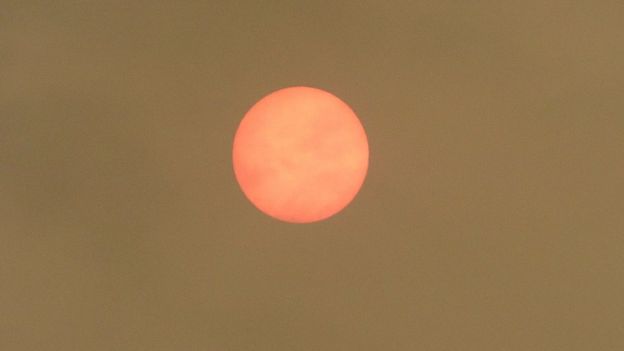
The Red Sun

Red sun phenomenon caused by Hurricane Ophelia
 
The phenomenon was initially seen in the west of England and Wales before spreading to other areas.
BBC weather presenter Simon King said it was due to the remnants of Hurricane Ophelia dragging in tropical air and dust from the Sahara. He added that debris from forest fires in Portugal and Spain were also playing a part. The dust has caused shorter wavelength blue light to be scattered, making it appear red.

He said: "Ophelia originated in the Azores where it was a hurricane and as it tracked its way northwards it dragged in tropical air from the Sahara." This meant dust from the Sahara was brought with it, he said. "The dust gets picked up into the air and goes high up into the atmosphere, and that dust has been dragged high up in the atmosphere above the UK," Mr King explained.
The particles in the air cause blue light to scatter, leaving longer-wavelength red light to shine through. The Met Office said the "vast majority" of the dust was as a result of forest fires in Iberia, which have sent debris into the air and that has been dragged north by Ophelia. 

 http://www.bbc.com/news/uk-england-41635906


Red sun

Thursday, October 5, 2017

Hurrican Ivan


On Sept 2, 2004, Tropical Depression Nine formed around 555 miles southwest of the Cape Verde islands. The depression turned into a tropical storm and was named Ivan the following day. Tropical Storm Ivan’s winds gradually rose to hurricane status 1,210 miles east of the Lesser Antilles. By 6 pm, Ivan grew into a category 3 (almost four) hurricane, with winds up to 125 mph. The National Weather service said that such rapid strengthening was unheard of at such low latitudes in the Atlantic basin.
Ivan maintained hurricane strength up until it reached central Alabama. It weakened down to tropical depression near northeastern Alabama. The remainder of Ivan was found in the mid-Atlantic coast of the U.S., but continued to dump rain on the east coast, due to low pressure disturbance.
By September 18th, Ivan lost tropical characteristics by the time it hit Virginia. On the morning of September 21st, a few of its remnants, along with a low-pressure system to pelt Cape Breton Island of Nova Scotia, Canada with few hurricane-force winds, flooding some roads, felling trees, and doing other damage.
Ivan lost tropical characteristics on September 18 while crossing Virginia. The remnant low crossed the coast of New Jersey later that day and advisories were discontinued. Nevertheless, on the morning of September 21, some of its remnants combined with a low-pressure system to pelt Cape Breton Island of Nova Scotia, Canada with hurricane-force winds, flooding some roads, felling trees, and leaving thousands without power. Ivan made a comeback on September 22, 2004 in the Gulf of Mexico, reforming into a tropical depression and causing tremendous flooding in the southeastern U.S.
Image result for hurricane ivanhttp://batterysavers.com/blog/hurricane-ivan-history/

Tuesday, September 26, 2017

Tropical Cyclone Report Hurricane Beatriz (EP022011) 19-22 June 2011


The birth of Beatriz was complex. On June 4, a tropical wave formed on the west coast of Africa and was detected in the western Caribbean sea by June 14. A kelvin wave from the western Pacific as enhancing low-level vorticity and upward vertical motion east of 110 w at the time the tropical wave reached the eastern Pacific on June 15. The wave entered this environment, favorably, and it was later revealed that a low- to mid-level cyclonic circulation formed along the wave South of El Salvador by June 16. During this time, a faster moving wave entered Central America, resulting in interaction of both waves southeast of Acapulco, New Mexico, on June 17.

Over the next 24 hours, convection slowly increased along the western end of the trough. The coverage of the convection briefly decreased after 0000 UTC, and on June 19 a concentrated burst of convection developed over the center around 0600 UTC.


Press reports reveal that heavy rains, high waves, and strong winds damaged portions of the coast of the Mexico from the states of Guerrero to Jalisco. Heavy rains uprooted trees and flooded homes and roads. The maximum reported rainfall amounts by state include 222.5 mm at Copala in Guerrero, 167.5 in Lazaro Cardenas in Michoacán. and 159 mm in Callejones in Colima.

http://www.nhc.noaa.gov/data/tcr/EP022011_Beatriz.pdf